
Is 2026 a good time to invest in Texas real estate? Learn how stabilizing rates, tax relief, and the affordability reset are creating prime opportunities.
If you’ve been sitting on the sidelines waiting for the real estate market to "crash" or for mortgage rates to miraculously drop back to 3%, you might be missing the best investment window of the decade.
After three years of wild bidding wars, skyrocketing prices, and rate-lock paralysis, the Texas housing market is undergoing what experts are calling "The Great Housing Reset". We aren't seeing a crash or a boom, but rather a functional, balanced normalization.
If your finances are in order, 2026 is presenting an opportunity-rich environment for real estate investors. Here is the breakdown of the macro tailwinds driving the state and a look at the top cities for your investment strategy.
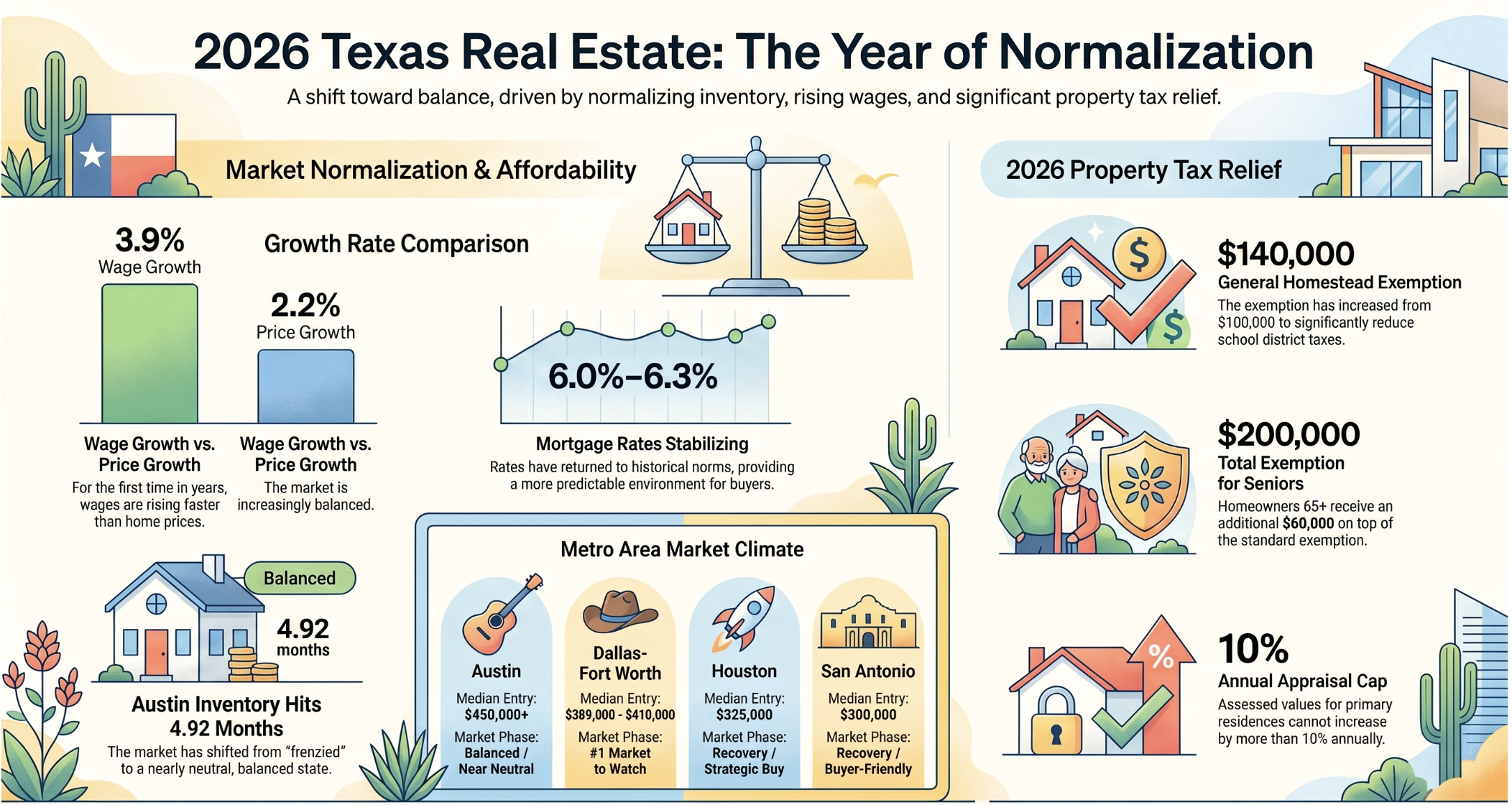
The Macro Tailwinds Driving Texas in 2026
1. The Affordability Reset For the first time since the Great Recession, wage growth is officially projected to outpace home price appreciation. Between 2019 and 2024, home prices surged by about 45% while wages only grew by roughly 20%. In 2026, this dynamic is reversing, meaning purchasing power is finally increasing month over month.
"For the first time in several years, the underlying forces are finally aligned toward gradual improvement... income growth exceeding house price appreciation will provide a boost to house-buying power, even in a higher-rate world." — Mark Fleming, Chief Economist at First American
2. Rate Stabilization (The New Normal) Major economists project that 30-year mortgage rates will stabilize and average between 6.0% and 6.3% throughout 2026. While this isn't the 3% pandemic-era rate, it perfectly mirrors the historical average of 6.3% seen between 1990 and 2020. Rates are no longer climbing unpredictably, giving investors the "breathing room" needed to underwrite deals confidently.
3. Historic Property Tax Relief Texas has implemented massive property tax relief measures that are fully anchoring the 2026 market. The state has increased the general homestead exemption to $140,000 to reduce taxable value for school district taxes. Furthermore, seniors and disabled homeowners receive an additional $60,000 exemption, bringing their total exemption to $200,000.
4. Unstoppable Job and Population Growth Texas continues to be a magnet for massive corporate relocations and population inflows. Over 100 corporate headquarters have relocated to the Dallas-Fort Worth area alone since 2018. The state's lack of an income tax, combined with diverse job sectors—from tech and healthcare to energy and defense—provides a permanent baseline of housing demand.
City-by-City Investment Outlook
Not all Texas markets are created equal. Here is how the state's major metros stack up for your portfolio:
🏆 Dallas-Fort Worth (DFW): The #1 Overall Market
- The Vibe: For the second consecutive year, DFW was named the #1 market to watch for overall real estate prospects by PwC. It is the ultimate "Goldilocks" market: it boasts incredible economic diversification and massive corporate relocations without the extreme volatility of other tech-heavy cities.
- The Strategy: Investors should look to single-family homes under $500k, which are rated a "Conditional Buy" with 78% confidence and gross yields around 6.8%. The smartest money is looking south toward Ellis County (cities like Waxahachie and Midlothian), where massive infrastructure projects are underway and homes can be purchased for 20-30% less than the northern suburbs. Click here for the latest under500k.ai report for Dallas
🔥 Houston: The High-Demand Engine
- The Vibe: Houston is a market in motion. With 110,000 net new jobs added recently and massive expansions in the Texas Medical Center and energy sectors, Houston's housing demand is accelerating. The median home price sits at $425,000, and correctly priced homes are flying off the market in an average of 28 days.
- The Strategy: Rated a "Conditional Buy" with 78% confidence, Houston remains highly investor-friendly due to lower entry pricing compared to Austin or Dallas. Single-family rentals in the suburbs are achieving impressive gross yields between 6.0% and 8.5%. Click here for the latest under500k.ai report for Houston, TX.
🛡️ San Antonio: The Safe, Cash-Flow Bet
- The Vibe: Nicknamed "Military City, USA," San Antonio’s economy is anchored by the Department of Defense, which generates over $55 billion annually in statewide impact. This federal footprint makes the Alamo City incredibly resilient to economic downturns.
- The Strategy: San Antonio is a "Conditional Buy" with a high 80% confidence rating for investors. It is ideal for steady, long-term workforce housing rentals, with typical rents hovering around $1,400 to $1,700 and properties boasting high occupancy rates with low turnover. Click here for the latest under500k.ai report for San Antonio, TX
📈 Austin: The Strategic Long-Term Play
- The Vibe: The frenzy of 2021 is over. Austin is currently in a "buyer's market correction," with housing inventory sitting around a much healthier 4.92 months. Active listings are giving buyers room to breathe and negotiate.
- The Strategy: Rated a "Conditional Buy" with 72% confidence, Austin requires patience. It is no longer a beginner's market, but experienced investors who can target affordable pockets under $500k and withstand slightly softer rent growth in the short term will benefit from Austin's formidable tech-driven fundamentals in the long run. Click here for the latest under500k.ai city report for Austin, TX
The Bottom Line
2026 is rewarding preparation and punishing passivity. The market is transitioning to a state where buyers and investors have more negotiating leverage, less frantic competition, and access to builder incentives.
What do you think? Are you holding out for another 2021-style rate drop, or are you ready to take advantage of the 2026 housing reset?
Written by
Under500K Team
Research and market insights for global property investors.