The 2026 Paris property market: stabilized prices, best-yield arrondissements, Grand Paris Express hotspots, and how energy ratings and STR rules reshape investor strateg
Beyond the "Wait-and-See" Era: The Stabilization of the €9,800 Floor###
The Paris real estate market has officially moved beyond the speculative fever of the post-pandemic years and the subsequent "wait-and-see" paralysis of the mid-2020s. As we navigate through 2026, the landscape is defined by a transition from volatility to a sophisticated "measured growth." We have successfully climbed out of the 2024 correction trough, where prices bottomed at a city-wide average of €9,600/m², to reach a stabilized benchmark of €9,827/m².
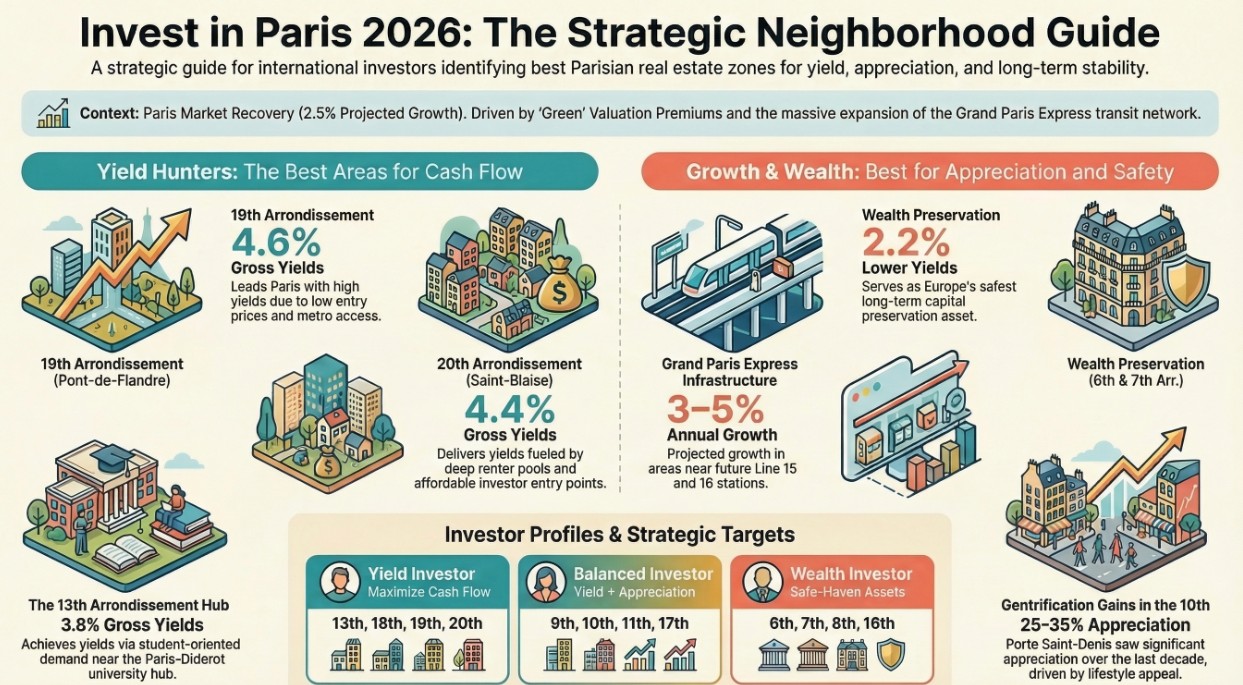
For the global citizen, this shift signals a return to fundamentals. The market is no longer a playground for the momentum trader, but a fortress for the long-term investor. This "rational era" prioritizes capital preservation and structural resilience over the quick "flip," reflecting a city that has reasserted its status as the ultimate anchor for international portfolios.
Truth #1: The "American Wave" is Prioritizing Neighborhood Rhythm over Postcard Addresses
The demographic shift in 2026 is undeniable: American buyers now represent a staggering one in four foreign transactions. While the historic dollar remains a catalyst, the motivation has evolved. The pursuit of the "symbolic address" in the 6th or 7th is giving way to a search for "lifestyle continuity."
Today’s American investor is looking for the "village atmosphere" of the Batignolles or the creative energy of the 9th arrondissement. They are trading the sterile prestige of the Right Bank's Golden Triangle for the "bucolic" charm of the Canal de l’Ourcq or the intellectual heritage of the Sorbonne. This is a move toward high-end livability—where the quality of the morning boulangerie run and proximity to bilingual schools matter more than a view of the Eiffel Tower.
MetParis Perspective: "Today’s international buyers are prioritizing neighborhood rhythm and lifestyle continuity over short-term speculation. They view Paris property not as a bet, but as a deliberate lifestyle decision—one that integrates culture, walkability, and architectural continuity into their long-term plans."
The market for these "intentional buyers" is currently bifurcated into two distinct strategic tiers:
- Premium Tier (e.g., 6e, 7e): €12,500 – €15,000/m² (Prestigious, supply-constrained cultural centers).
- Value Entry Tier (e.g., 12e, 19e, 20e): €7,300 – €9,300/m² (High growth potential near green spaces).
Truth #2: The Best Yields Hide in the "Boring" Arrondissements
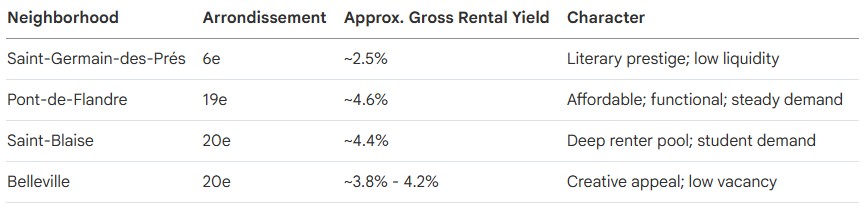
In 2026, the savvy strategist knows that "boring and functional" is the new profitable. While the ultra-chic center offers the allure of the monument historique, it delivers the city's lowest yields. The real hunting ground for gross rental returns has shifted to the 19th and 20th arrondissements.
The financial logic is simple: in these outer "quartiers," purchase prices have dropped significantly faster than rents. Deep local renter pools, comprised of young professionals and students, ensure that vacancy rates remain near zero while yields approach the 5% mark.
Truth #3: The Short-Term Rental Trap and the "Loi Le Meur"
The "Airbnb gold rush" has officially met its regulatory executioner. Under the strictures of the November 2024 Loi Le Meur, the City of Paris has intensified its war on short-term rentals (STR). Prime tourist zones—the 1er, 4e, and 6e—are now considered "oversaturated," with micro-zones where active listings once exceeded 10% of total housing stock now under heavy municipal surveillance.
Investors must strictly adhere to the 90-day annual cap for primary residences. For those attempting to operate commercial STRs without the arduous "change of use" authorization, the financial penalties are no longer a mere cost of doing business—they are catastrophic, with fines now reaching €50,000.
Chambre des Notaires Warning: "The density of active listings in core districts has triggered a 'heightened enforcement' phase. The city is committed to rebalancing the housing stock, creating significant legal and financial risk for those entering the short-term market without a strict compliance strategy."
Truth #4: Infrastructure as Destiny — The Grand Paris Express Catalyst
In the 2026 market, transit connectivity is the ultimate predictor of value. The rollout of the Grand Paris Express—particularly Lines 15, 17, and 18—is redrawing the map of appreciation. Historically, neighborhoods gaining new metro access see price increases of 5% to 15%, and the current focus is on the Noisy-Champs multimodal hub.
While the Greater Paris office market contracted by 11% in previous years, the Eastern Paris tertiary hub remained remarkably stable at 57,400 sq m of take-up. This resilience, anchored by institutions like CFA Descartes and Gustave Eiffel University, makes residential investments in Noisy-Champs and Montévrain particularly attractive. Strategic investors are looking at the 2026 delivery pipeline of new assets, such as the "Mayfair" project in Chessy or the "West Park" development in Serris, as prime indicators of where the next wave of professional tenants will settle.
Truth #5: The "Green" Valuation Gap — Converting Hazards into Alpha
Energy performance is no longer a "nice-to-have" feature; it is a central pillar of valuation. We are seeing a widening price gap based on Energy Performance Certificate (DPE) ratings that smart money is exploiting.
- A-B Rated Properties: Command a 10% to 15% premium due to "green value" and regulatory safety.
- G-Rated "Passoires Thermiques" (Thermal Sieves): Face discounts of up to 25% in transitional neighborhoods like Goutte d’Or-Chateau Rouge.
The most fertile ground for negotiation in 2026 lies in "D" and "E" rated properties. Forward-thinking investors are using these ratings as leverage to secure discounts before the most stringent renovation mandates take effect, manufacturing appreciation through energy-efficient retrofitting.
The Suburban Duel: Pantin vs. Saint-Ouen
For those pushed beyond the périphérique by Parisian price points, the debate has narrowed to two gentrifying titans. Both offer a "bobo" (bourgeois-bohemian) lifestyle, but the "boots-on-the-ground" reality differs significantly.
Pantin: The "Brooklyn" of the East
- Pros: The "Golden Triangle" food shops and artisanal boulangeries offer a level of authenticity unmatched in the suburbs. The "bucolic" Canal de l’Ourcq provides a serene lifestyle for young families.
- Cons: Commutes to La Défense remain long. While safer than its reputation, certain hubs like Hoche still grapple with persistent street vendors and localized "shady" atmospheres under the Villette bridge.
Saint-Ouen: The Connectivity King
- Pros: The Line 14 extension is a golden ticket, offering faster access to central Paris than many "intra-muros" neighborhoods. Families benefit from innovative Scandinavian-inspired anti-bullying programs in local schools.
- Cons: The "Docks" district, while full of new-build infrastructure, is often criticized for a lack of "soul." More pressingly, summer residents complain of the "stinging eyes and nose" caused by the proximity of the local incinerator—a sensory detail often omitted from glossy brochures.
Conclusion: Paris as the Ultimate Anchor City
As we look toward the horizon of 2027, Paris remains the premier "anchor city." In a world of increasing volatility, it is a market that rewards asset quality and a long-term horizon. With its supply-constrained heart and massive infrastructure expansion at the periphery, it offers a unique combination of low volatility and high cultural relevance.
The question for the 2026 investor is no longer about timing the bottom, but about the nature of their intent. Are you seeking a mere financial instrument, or are you looking to secure an enduring way of life?
Written by
Under500K Team
Research and market insights for global property investors.