Discover the seven critical legal, tax, and financing realities investors must understand before buying property in Costa Rica in 2026, from Maritime Zone traps to seller
The "Pura Vida" dream—waking up to the sound of howler monkeys and the Pacific surf—remains a powerful motivator for North American and European investors in 2026. Costa Rica’s stable democracy and equal property rights for foreigners continue to anchor its appeal. However, the market has matured into a sophisticated phase where "gut feeling" is no longer a viable strategy. Beachfront dreams now frequently collide with the technical complexities of the Maritime Zone Law, and high-yield expectations are often eroded by hidden management markups. This playbook reveals the seven most impactful, counter-intuitive takeaways from current market data, ensuring you navigate regional corrections and regulatory minefields without overpaying for hype or falling into avoidable legal traps.
The 200-Meter Trap: Why "Beachfront" Isn't Always "Owned"##
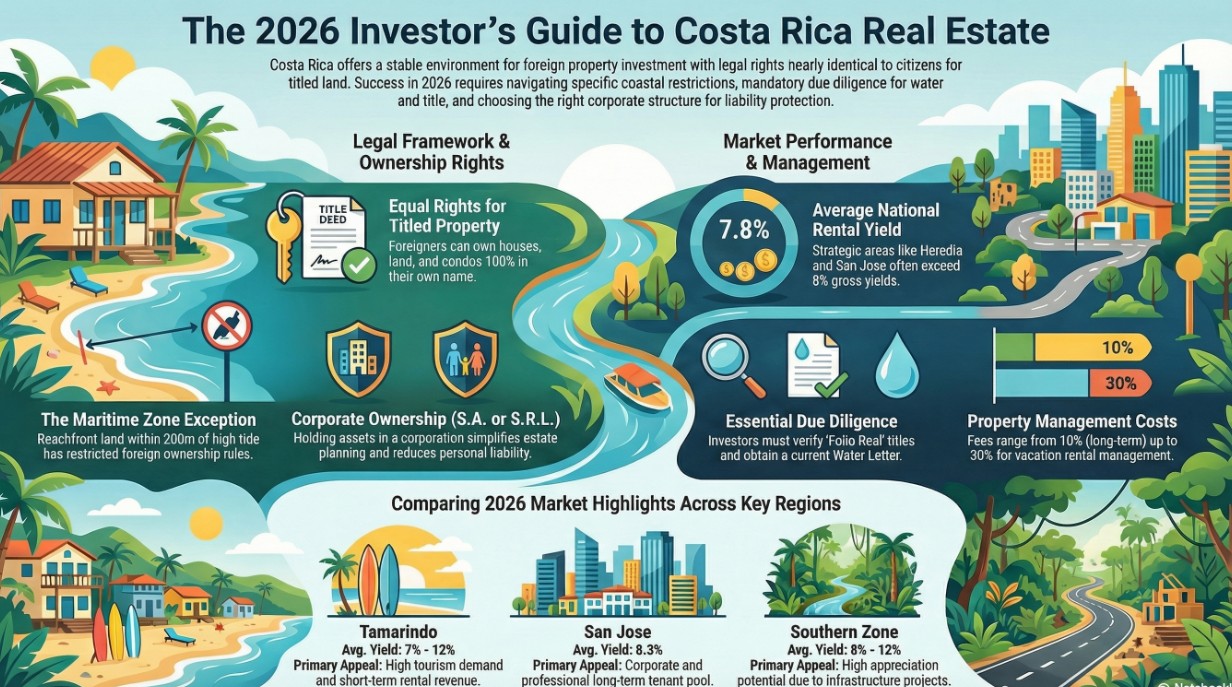
One of the most significant pitfalls for foreign investors is the assumption that "beachfront" carries the same fee-simple rights as inland property. Under the Maritime Zone Law (Ley 6043), the first 200 meters from the high-tide line is governed by a complex concession system.
This zone is divided into two distinct legal tiers:
1. The Public Area: The first 50 meters from the high-tide line. This area is strictly off-limits for private ownership or development. 2. The Restricted/Concession Area: The remaining 150 meters. Development here is granted via a "concession"—essentially a 20-year lease from the local municipality.
The reality for 2026 investors: foreigners cannot hold a concession unless they have resided in the country for at least five years. Furthermore, any corporation holding a concession must be at least 50% owned by Costa Rican citizens. Even for those who qualify, the fiscal reality is steep; the government mandates a 2.5% withholding tax on the gross sales price for non-resident sellers as an advance payment on capital gains.
"The legal basis for this restriction is the Maritime Zone Law (Ley 6043), which treats the first 200 meters from the high tide line as national patrimony that cannot be privately owned."
Strategic Takeaway: If you aren't a five-year resident, target "titled" property just outside the 200-meter zone in areas like Escazú or Atenas, where you enjoy absolute fee-simple rights identical to those of a local citizen.
The #1 Deal-Breaker: The "Carta de Agua"
In high-demand mountainous regions like Atenas and Grecia, the most critical factor for investment security isn't the panoramic view—it is the Carta de Agua (Water Letter). Without this current, valid document from AyA (the national water authority) or the local ASADA (rural water board), building is illegal, rendering your land a high-risk, unbuildable asset.
In 2026, savvy investors must also account for municipality-imposed building moratoriums driven by micro-climate water scarcity.
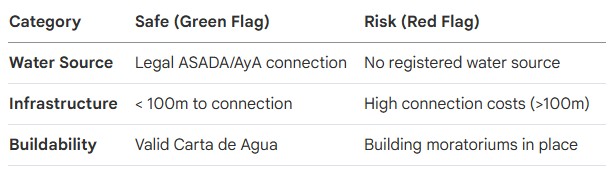
Strategic Takeaway: Distance to infrastructure is a hidden cost multiplier. If your connection point is over 100 meters away, your development costs will surge exponentially, regardless of what the sales listing claims.
The "Ace Up Your Sleeve": Seller Financing
Traditional bank mortgages have become a bureaucratic bottleneck in 2026. Local institutions often require 45 to 90 days for due diligence and typically limit non-residents to a 50–60% Loan-to-Value (LTV) ratio, necessitating massive 40–50% down payments.
The strategic "Ace" in this tight market is Owner Financing. This trend has transformed growth hubs like Tamarindo and Nosara, allowing liquidity-conscious buyers to bypass high formalization costs and strict debt-to-income ratios.
"Owner financing... eliminates bank bureaucracy and allows for direct negotiations... [it] is the best way to buy a home in Costa Rica with seller financing, especially if you are waiting for the sale of another asset in your home country."
Strategic Takeaway: Standard structures in 2026 involve a 30–50% deposit with a "balloon payment" due in 3 to 5 years. This allows you to close in as little as 7–15 days while maintaining capital for other investments.
Hidden Erosion: The 20% Maintenance Markup
When evaluating property management, the base fee is often a decoy. While many firms advertise a 10% management fee for long-term rentals, they frequently use a "20% markup" on all repair costs to subsidize their operations. If a contractor bills $1,000 for a roof repair, you are invoiced $1,200.
Strategic Takeaway: To protect your net ROI, look past the base fee and demand a "Total Cost of Ownership" (TCO) breakdown. Specifically, ask for a written policy on maintenance markups; the most transparent firms bill maintenance at actual vendor rates and prioritize long-term asset value over service markups.
Paradise Satiety: The Tamarindo vs. Southern Zone Divergence
The 2026 data indicates a sharp divergence between saturated luxury hubs and emerging growth zones. Central Jacó and Tamarindo are currently in a "Correction" phase, with Jacó hosting over 4,000 active listings and Tamarindo’s inventory growth outpacing tourist arrivals. Generic properties in these areas struggle during the low season (September–October), with occupancy often plunging below 25%.
Conversely, the Southern Zone (Uvita and Ojochal) has emerged as the market leader, boasting 42% year-over-year growth. While Guanacaste luxury premiums can reach $4,700/sqm, the Southern Zone offers a superior growth-to-value ratio.
Strategic Takeaway: Contrast this with the "Recovery" phase seen in San José (Rohrmoser/Escazú), where professional tenant demand keeps yields stable at 7–8%. Invest where infrastructure expansion is pending, not where the market has already peaked.
The "Dirty" Corporation: A Due Diligence Minefield
While purchasing property via a Share Purchase Agreement (SPA) can theoretically simplify a transfer, it is a legal minefield of "sloppy corporate housekeeping." Buying a corporation means you inherit its entire history, including unknown liabilities and unpaid taxes.
Modern compliance in Costa Rica is rigorous. You must verify:
- RTBF Compliance: The corporation must have a clean history with the Transparency Registry (Registro de Transparencia y Beneficiarios Finales).
- Authenticated Books: Ensure the Shareholder Registry and Minutes books are legally authenticated and up to date.
Strategic Takeaway: A "set it and forget it" mindset is dangerous. If the seller cannot produce authenticated corporate books or proof of RTBF filings, the "simple" share purchase becomes an expensive legal cleanup project.
The July 2020 Time-Warp: A Capital Gains Secret
A critical tax advantage exists for properties acquired before July 1, 2020. Under current tax rulings, owners of these "pre-reform" assets have a strategic choice upon resale:
-
Pay a 15% tax on the net capital gain (sales price minus historical cost).
-
Pay a 2.25% tax on the total gross sales price.
For assets acquired after July 1, 2020, the standard 15% rate applies. Strategic investors should always run both calculations to determine which results in the lower tax liability.
Strategic Takeaway: Remember the 2.5% non-resident withholding tax. If you are a non-resident seller, the purchaser is legally required to withhold this amount from the transaction price as a final advance payment, simplifying the exit but requiring careful net-proceeds modeling.
The Forward-Looking Summary: Strategy Before Emotion
Success in the 2026 Costa Rican market requires local expertise and technical due diligence over "gut feeling." While foreigners enjoy exceptional rights to titled property, the "hidden" details—from the distance to water infrastructure to the compliance of corporate books—define your ultimate ROI.
As the 2026 market corrects in luxury hubs while surging in the Southern Zone, are you buying for the view you see today, or the infrastructure that will be there tomorrow?
Written by
Under500K Team
Research and market insights for global property investors.