Foreign buyers face a federal purchase ban, a 35% speculation tax, oversupply, and sub‑2% cash returns in Toronto’s condo market.
Toronto remains the glittering centerpiece of Canada’s economic engine—a tech-heavy, immigrant-rich metropolis that, on paper, should be a "buy and hold" paradise. But for the international investor looking to deploy a $500,000 budget, the view from the ground is far less scenic. In fact, our current analytical verdict is a cold, hard REJECT.
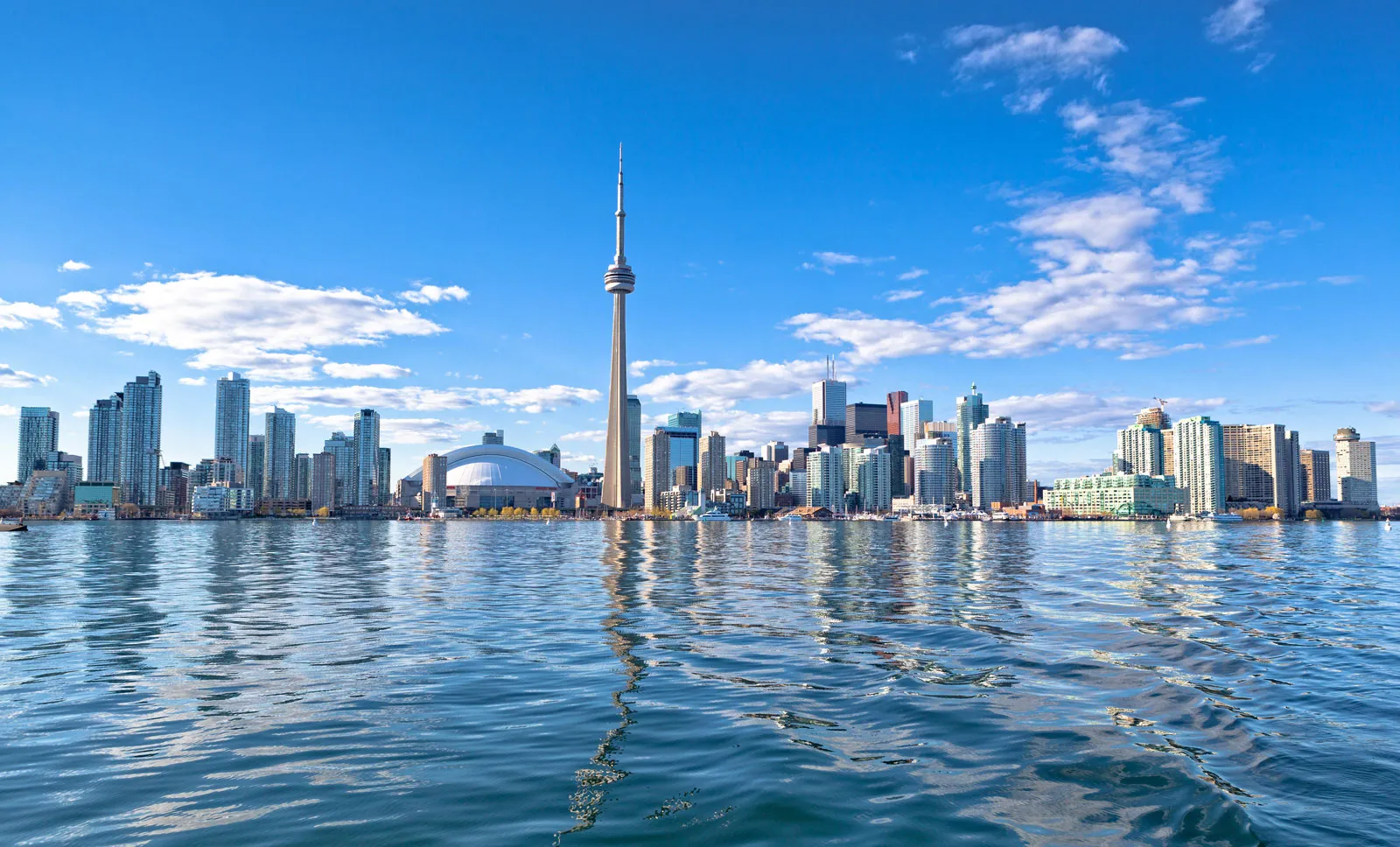
While local boosters point to the skyline, a sober look at the data reveals a market that has transitioned from a growth engine to a "no-go" zone for foreign capital. Unless you are looking specifically at the commercial sector—which remains a strategic, exempt loophole—the residential market is currently a graveyard for international yields. If you are eyeing a Toronto condo, here is why your plan is less of an investment and more of a mathematical impossibility.
1. The "Hard No": The Federal Ban Until 2027
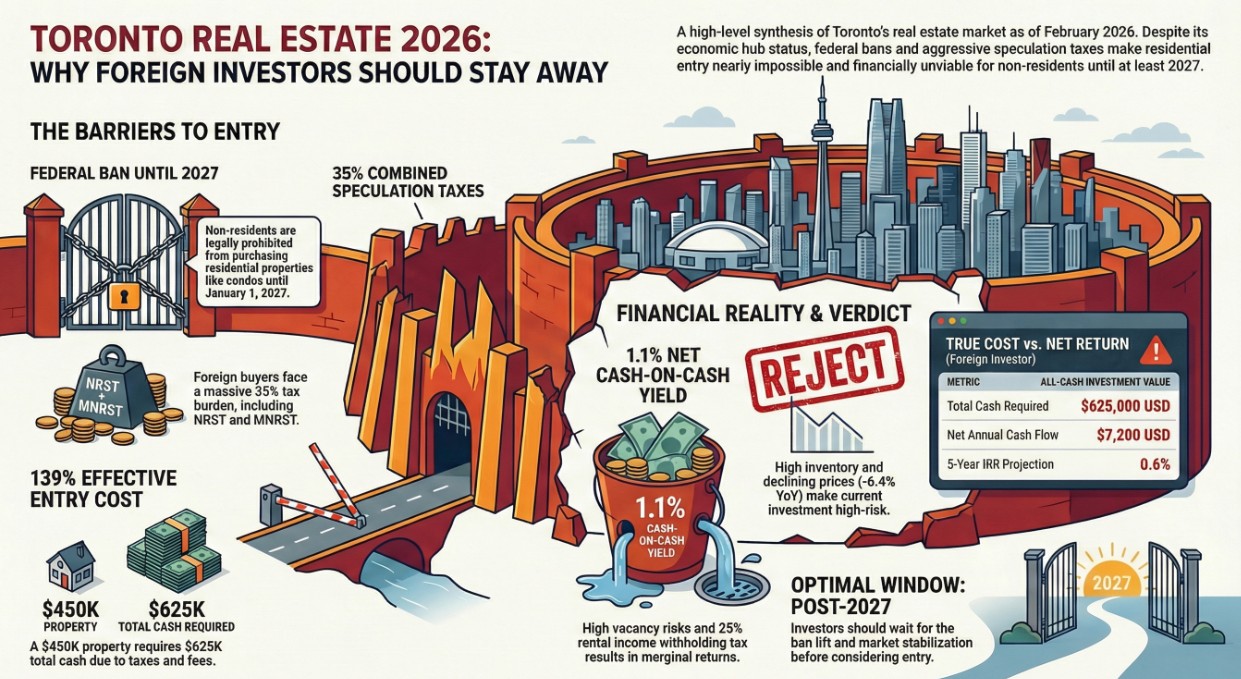
The first wall an investor hits isn't market-driven; it is legislative. The Canadian government has slammed the door shut on foreign residential acquisitions, extending the prohibition until January 1, 2027. For the average global investor, the needle's eye of exceptions—restricted to specific long-term work permit holders and select student statuses—is far too small for a $500,000 portfolio to pass through. This isn't a hurdle; it’s a total lockout.
Executive Verdict: "Foreign investors are prohibited from purchasing residential properties like condos in Toronto... making entry impossible without qualifying for narrow exceptions." Crucially, this ban is sector-specific. While it renders residential "entry" a legal impossibility, it notably exempts commercial real estate. However, for those determined to own a piece of Toronto’s "roofs," the conversation has shifted from "when the price is right" to "if it is legally permitted." Until the 2027 reset, residential capital is effectively persona non grata.
2. The 139% Entry Cost: The Math of "Trapped Equity"
Even for those who squeeze through a legal exception, the entry costs are staggering. In Toronto, a $450,000 "bargain" is a fiscal illusion. To actually hold the keys, a non-resident must navigate a tax gauntlet that turns a $500k budget into a deficit. The Sunk Cost Breakdown: • Non-Resident Speculation Tax (NRST): 25% • Municipal Non-Resident Speculation Tax (MNRST): 10% • Total Speculation Burden: 35% ($157,500 on a $450k property) • Total Effective Entry Cost: 139% (approx. $625,000 USD total cash required)
This $157,500 tax hit is a pure sunk cost with a 0% ROI. Because the market is currently in a "Correction Phase" (-6.4% YoY), an investor paying this 35% premium today would likely need over a decade of average market growth just to reach the break-even point on the tax alone. This is the definition of "trapped equity"—capital that is locked into an asset with no hope of recovery in the near-to-medium term.
3. The Oversupply Paradox: 31,000 New Reasons to Wait
In real estate, supply is usually a sign of health, but in Toronto, it has become a price-suppression "perfect storm." The city is currently bracing for a peak supply wave that makes buying today look like fiscal suicide. In 2025, the market will attempt to absorb 31,000 new completions. To put that in perspective, the pipeline drops to 17,000 in 2026 and less than 10,000 in 2027. Entering the market during the 2025 peak means you are buying at the exact moment when inventory is most likely to crush pricing power. With sales already low and prices trending downward, this oversupply serves as a massive red flag for any investor seeking short-term stability.
4. The Yield Trap: The Anatomy of a 1.1% Return
On the surface, a 6.7% gross yield in North York might look enticing. But for the non-resident, the "silent killers" of cash flow quickly erode that figure into a rounding error. The Leakage Logic (Monthly Example): • Gross Rental Income: $2,100 • Less Vacancy (10%): ($210) • Less Operating/Management (10%): ($525) • Less Property Taxes: ($225) • Net Operating Income (3% Cap Rate): $1,140 • Less Non-Resident Withholding (25%): ($520) • NET CASH FLOW: $620 (1.1% Cash-on-Cash Return)
The situation worsens if you use financing. With borrowing costs hovering at 4.5% and a property Cap Rate of only 3%, you fall into the "Negative Leverage" trap. Every dollar of debt you take on actually erodes your wealth because the cost of the money is higher than the asset's yield.
Analysis Verdict: The financial math for leveraged scenarios is "Marginal/Negative," with an Internal Rate of Return (IRR) of -0.2%. You are essentially paying for the privilege of owning the asset.
5. The "Wait-and-See" Dividend: Patience as a Profit Center
In the current Toronto climate, doing absolutely nothing is the most profitable move an investor can make. Our price sensitivity analysis shows that the market is structurally biased toward further declines. • Action: Buy a $450,000 unit today. • Strategic Alternative: Wait 6 months. • The Result: The same unit is forecasted to cost $435,000.
By staying on the sidelines, you "earn" a $15,000 dividend in the form of a lower entry price. With the market expected to dip further during the 2025 oversupply peak, there is zero statistical advantage to rushing. The smart money is waiting for the "2027 Reset"—the moment when the ban expires and the supply pipeline finally tightens.
Conclusion: The Future Beyond the Ban
Toronto’s long-term story isn't over. The city's status as a tech and finance hub remains undisputed, and its healthcare and education systems are world-class. However, as an investment destination for the next 24 months, the residential sector is rated "Extreme Risk." For those with capital ready to move, there are two rational paths: pivot to commercial real estate, which bypasses the ban and offers more robust institutional protections, or reallocate your $500,000 to higher-yield, lower-friction markets elsewhere. The Toronto mirage may be beautiful, but the math says it’s time to look away until 2027.
Written by
Under500K Team
Research and market insights for global property investors.