
Unlock the hidden mechanics of U.S. real estate in 2026 with this guide for international investors, covering tax rules, legal risks, financing constraints.
The United States real estate market remains the preeminent safe haven for global capital, recently facilitating over $53 billion in international acquisitions. To the overseas observer, the allure is obvious: a landscape of unparalleled transparency, robust property rights, and the "natural hedge" provided by dollar-denominated assets. Yet, for many, this safe haven contains a "hidden architecture" of tax treaties, shifting affordability metrics, and legislative barriers that can dismantle a portfolio before the first rent check is even cashed.
As we move into 2026, the era of passive entry is over. Success now requires the technical precision of a CPA and the strategic foresight of a seasoned strategist. Navigating the maze of FIRPTA, ITINs, and the escalating "Minimum Income" barrier is no longer optional—it is the prerequisite for wealth preservation in the American market.
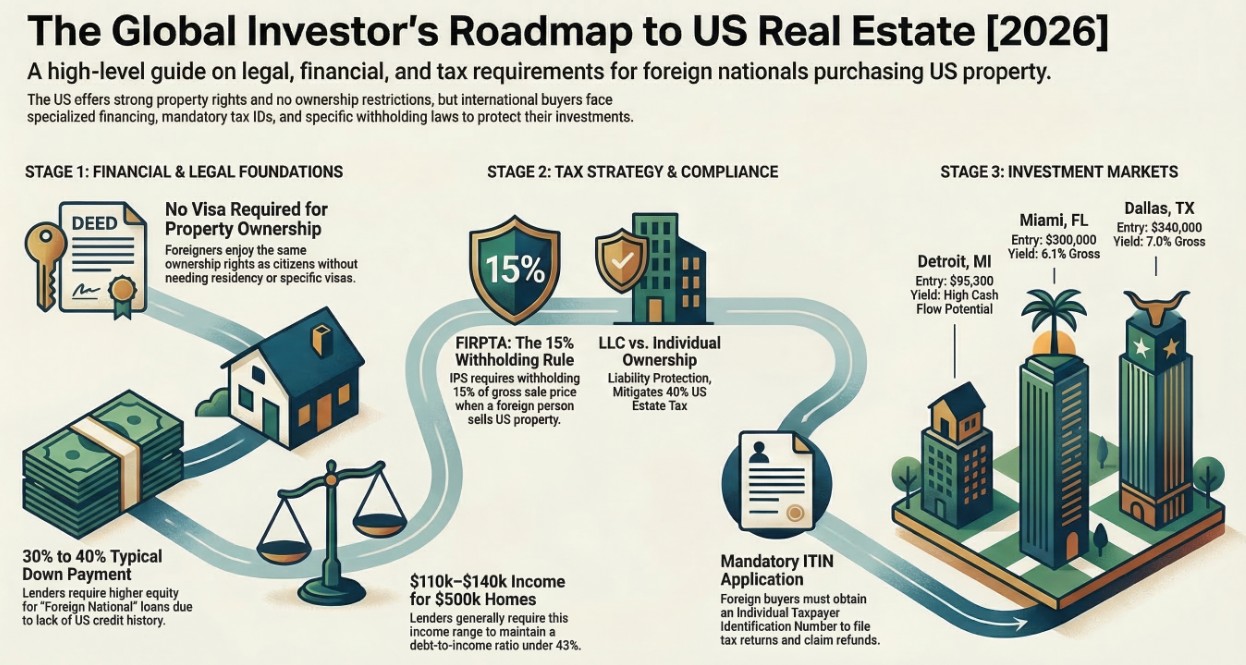
1. The 40% "Death Tax" Trap: Why Your Ownership Structure Matters
The primary predatory element for international wealth in the U.S. is the federal estate tax. While a domestic investor enjoys an exemption reaching into the millions, a non-resident alien is granted a meager $60,000 exemption on "U.S.-situated assets."
If a foreign individual holds title to a $1,000,000 property in their own name and passes away, the IRS views $940,000 of that value as taxable. At a top estate tax rate of 40%, heirs could be forced to liquidate the asset simply to settle a $376,000 tax bill. Sophisticated capital avoids this snare by utilizing legal entities—such as LLCs, partnerships, or foreign corporations—to shield the individual from direct exposure and ensure the continuity of the investment.
"The most important and critical aspect of investment in US real estate is to determine the proper legal entities (LLC, corporation, partnership, trust, etc.) to hold title (own) the properties. This structure of entities must be designed to meet your goals and objectives... Failure to plan in advance can be extremely costly." — Steven E. Miller, CPA
Furthermore, the "Hidden Architecture" of 2026 includes new legislative hurdles. Statutes like SB 17 in Texas and SB 264 in Florida now restrict or prohibit property purchases by citizens or entities from specific countries (including China, Russia, Iran, and North Korea) near critical infrastructure. Verification of eligibility is now the first step in any structural audit.
2. The 30% "Gross vs. Net" Election: A Simple Paperwork Pivot
The IRS defaults to a punitive tax treatment for foreign-owned rental income, classifying it as "Fixed, Determinable, Annual, Periodic" (FDAP). Under this regime, the owner is taxed at a flat 30% on gross rents, with no deductions allowed for mortgage interest, property taxes, or repairs.
To achieve "net-basis rentals," an investor must proactively make an "Effectively Connected to a U.S. Trade or Business" election. Without this simple paperwork pivot, a building that is losing money on paper could still trigger a massive tax liability.
STRATEGIC SNAPSHOT: THE "NIGHTMARE" CALCULATION
Scenario: A commercial building with $100,000 in rental income and $110,000 in operating expenses.
- The Default (No Election): The IRS ignores the $110,000 in expenses. You owe 30% of the gross $100,000. Tax Due: $30,000.
- The Election (Net Basis): You report a $10,000 loss. Tax Due: $0.
Failing to file this election transforms a stable asset into a liquidity crisis.
3. The $140,000 Entry Barrier: Redefining Affordability in 2026
The threshold for entering the U.S. market has shifted significantly. While the National Association of Realtors (NAR) projects mortgage rates may soften toward 6.0% in 2026, lending standards have reached a new peak of stringency. For a mid-market $500,000 home, the "minimum income" required to qualify has moved beyond the reach of the average earner.
The Monthly Cost Reality ($500,000 Property):
- Mortgage (Principal & Interest): ~$2,398 (at 6.0%)
- Property Taxes: ~$458
- Insurance & PMI: ~$300 – $500
- Total Monthly Commitment: $3,156 – $3,356+
Minimum Income Requirements: Affordability is dictated by the down payment lever. While a 20% down payment eliminates Private Mortgage Insurance (PMI), many international buyers find that utilizing 3.5% to 5% down payment programs (where available) pushes the required annual income into the $130,000 to $140,000 range to satisfy debt-to-income (DTI) ratios. To qualify at these levels, lenders typically demand that housing expenses do not exceed 28% of gross monthly income.
4. The Midwest Yield Miracle: Detroit and Cleveland vs. The Sun Belt
While global headlines focus on the "glamour" markets of Miami and Austin, sophisticated investors are pivoting toward the mathematical resilience of the Midwest. High-growth Sun Belt markets offer appreciation, but their entry prices often compress yields to negligible levels.
Market Comparison (Median Sold Prices):
- Detroit, MI: $95,300
- Cleveland, OH: $136,500
- San Antonio, TX: $289,400
- Dallas, TX: $340,000
The defining metric for 2026 is the Rent-to-Price ratio. A lower ratio indicates more rent collected relative to the property's value. Cleveland currently boasts a ratio of 10.44, a staggering advantage compared to the national average of 23.02.
"Though Detroit, Michigan, has significantly shrunk since its peak in 1950, it's starting to grow again due to the city's revitalization efforts... Home prices are low compared to the rest of the U.S." — Market Insight, PropStream
For the investor with limited capital, these manufacturing hubs provide a "yield miracle" that coastal condos simply cannot match in the current interest rate environment.
5. The FIRPTA "Security Deposit": It’s a Holdback, Not a Tax
The Foreign Investment in Real Property Tax Act (FIRPTA) is often the final "shock" for the international seller. It is frequently misunderstood as an additional tax; in reality, it is a 15% withholding—a "security deposit" remitted to the IRS by the buyer to ensure capital gains taxes are covered.
To mitigate this blow to liquidity, sellers can apply for a Withholding Certificate before the closing date. If the seller can demonstrate that their actual tax liability will be significantly lower than the 15% holdback, the IRS may authorize a reduced withholding, preserving the seller's cash flow at the point of exit.
The ITIN Necessity: The Individual Taxpayer Identification Number (ITIN) is the linchpin of this process. It is required not only for the seller to eventually reclaim excess withholding but also for the buyer. Without a valid TIN for both parties, the IRS cannot properly credit the remittance, potentially leaving the buyer personally liable for the seller’s tax obligations—a catastrophic oversight in a cross-border transaction.
Conclusion: The Strategy of the Informed Investor
U.S. real estate in 2026 is a game of margins and mandates. Success is no longer found in the property itself, but in the planning that precedes the purchase. The most resilient portfolios are those built upon a "boots on the ground" team—CPAs who understand permanent establishment risk, attorneys who can navigate SB 17 restrictions, and agents who prioritize net yield over coastal prestige.
As you evaluate your next move, ask yourself: Are you chasing the aesthetic allure of a high-rise, or the mathematical stability of a structured Midwest investment? In the current market, the architecture of the deal is far more valuable than the bricks and mortar of the building.
Written by
Under500K Team
Research and market insights for global property investors.