
Discover data-driven analysis of Seattle real estate investment opportunities under $500K with AI-powered neighborhood scores, rental yields, and risk metrics to help you
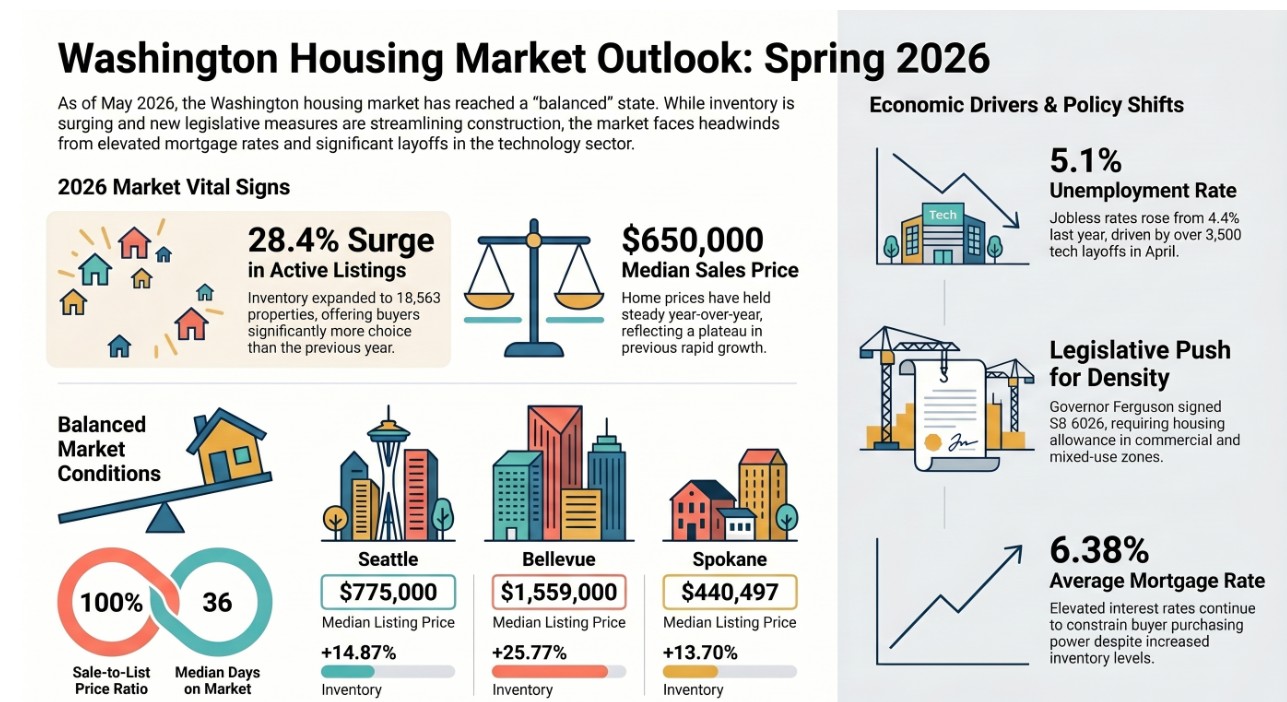
The Washington real estate market reached a significant milestone in May 2026, officially transitioning into a "balanced" state for the first time in years. While the relatable frustration of high entry prices hasn't vanished, the landscape is shifting under the feet of buyers and sellers alike. The most visible signal of this reset? A massive surge in availability, with 48,805 homes for sale across the state.
This transition isn't just a cooling of post-pandemic fever; it is a calculated result of aggressive state legislation meeting a diverging regional economy. To navigate this new terrain, residents must look past the headlines to understand the legislative and data-driven shifts currently redefining the Evergreen State.
-
Your Next Neighborhood Might Be a Former Best Buy
One of the most transformative shifts in Washington’s urban policy is Senate Bill 6026. This legislation targets jurisdictions with populations over 30,000, effectively mandating that housing be allowed in commercial and mixed-use zones. The goal is to solve two problems at once: the housing shortage and the blight of vacant retail spaces.
To ensure these projects are financially feasible, the bill limits local governments' ability to mandate "ground-floor commercial" space to no more than 40% of the total acreage. However, as an expert analyst would note, the bill includes critical carve-outs: these mandates are lifted except in industrial zones, station areas, and historic landmarks. This allows developers to prioritize residential density where it is most needed while preserving the character of specific transit hubs.
As Senator Emily Alvarado (D-Seattle) noted during the bill's signing:
“With this legislation, vacant strip malls, abandoned big-box stores and empty parking lots can be transformed into housing. This bill removes unnecessary barriers and makes it easier to build the homes our communities need.”
-
The Inventory Explosion (and the Price Paradox)
Data from Realtor.com highlights a startling "inventory explosion." Active listings in Washington have surged 17.22% year-over-year, bolstered by a 12.83% jump in new listings between April and May 2026 alone.
Yet, we are witnessing a clear "Price Paradox." While the median listing price remains a high $640,000—a modest 1.39% dip from last year—the median sold price has settled at $609,000. This $31,000 gap is the definitive proof of a market in transition; sellers are still listing with premium expectations, but buyers are no longer willing to meet them, resulting in significant over-reaching by the "old guard" of sellers.
Statewide Stats at a Glance (May 2026)
- Active Inventory: 48,805 Listings
- Median Listing Price: $640,000
- Median Sold Price: $609,000
- Median Days on Market: 36 Days
- Median Rental Price: $2,095/month
-
A Tale of Two Washingtons: Regional Divergence
The statewide "balanced" label masks a sharp divide between different corners of the state. In this new landscape, location prestige is being weighed against pure negotiation leverage.
The Winners: Tri-Cities and King County The Tri-Cities area is the state's unexpected powerhouse. In April 2026, the average sale price hit $497.2K—just $2.8K shy of the historic $500K threshold. This represents the highest average in the available dataset, signaling robust demand in the southeast. Meanwhile, King County remains the "luxury leader" with a median sold price of $822,500. Despite a 4.4% year-over-year decrease, it remains a tight market with just 3.3 months of inventory and a competitive sale-to-list ratio of 100.3%.
The Losers: Spokane and Clark County For those seeking leverage, the inland empire is the place to be. Spokane County has seen a massive 33.1% year-over-year median price drop, falling to $355,000. With inventory climbing to 4 months and a sale-to-list ratio of just 97.3%, buyers in Spokane now have the strongest hand in the state. Clark County mirrors this trend, offering similar inventory levels and a buyer-friendly 20 days on the market.
-
The Tech Sector Stress Test
Washington’s housing resilience is currently being tested by a volatile labor market. According to the April 2026 OFM Economic Report, the state recorded 3,587 layoffs. These were heavily concentrated in the tech sector: Amazon alone accounted for 2,599 impacted workers (comprising 2,198 direct layoffs and 401 closures), followed by 637 cuts at T-Mobile.
In a vacuum, such layoffs paired with a 5.1% unemployment rate would suggest a market crash. However, the housing market remains "balanced" rather than broken due to resilient business activity in other sectors. The Manufacturing Purchasing Managers’ Index (PMI) stands at 52.7 and the Services PMI at 54.0. Both indices indicate continued expansion, providing an economic buffer that prevents tech sector volatility from triggering a broader housing collapse.
-
Radical Transparency and Rural Flexibility
A new slate of housing bills, signed as part of Governor Ferguson’s "Governor Request Legislation," is moving the needle on transparency and rural land use.
- Environmental Accountability: Senate Bill 6237 now requires landlords to provide mandatory flood risk disclosures. This is an environmental reality check for renters, bringing Washington’s standards in line with states like Oregon and California.
- The Rural ADU Revolution: House Bill 1345 now authorizes rural detached Accessory Dwelling Units (ADUs). While this facilitates "family compounds" for multi-generational living, the bill crucially includes protections for rural resource management, including specific standards for water use by these new units.
During a signing ceremony at HopeWorks Station in Everett, Governor Ferguson emphasized the long-term intent of these policies and the new Department of Housing Task Force:
“This bill removes barriers to clear the way for more housing all across Washington.”
Is the "Balanced Market" Here to Stay?
The 2026 housing reset proves that while supply is finally catching up to demand, price relief is a local, not global, phenomenon. The state’s move to create a cabinet-level Department of Housing signals that the era of treating housing as a passive issue is over.
As we look toward the second half of the year, the fundamental question for any Washingtonian looking to move is no longer "Can I find a home?" but rather: Do you value the established prestige and school-district stability of King County, or the raw negotiation leverage and affordability currently trending in Spokane and Clark County?
For a detailed city report for Seattle please visit this link: https://www.under500k.ai/app/reports/seattle-united-states-20260523-224043
Written by
Under500K Team
Research and market insights for global property investors.