2026 global real estate guide for foreign and non‑resident investors. See how taxes, bans, and weak yields in Toronto, Spain, and Bahamas compare to Dubai’s 0%-tax opp.
The Global Property Trap: 4 Shocking Realities of International Investing in 2026
1. Introduction: The Siren Song of Foreign Postcards
For decades, the seduction of offshore real estate was simple: buy a high-yield rental in a world-class city, collect passive income in a hard currency, and watch as global demand pushes your equity into the stratosphere. It was a strategy built on the "Golden Era" of open borders for capital, low interest rates, and governments that welcomed foreign investors with open arms.
But by 2026, the data performs an autopsy on that dream. We have entered the era of "Legislative Decapitation," where non-resident investors are no longer seen as economic assets, but as political liabilities to be taxed, banned, or legislated out of existence. While the dream remains a staple of wealth-building mythology, the modern international investor is walking into a landscape of evaporating liquidity and aggressive protectionism. For the undisciplined, the postcard isn't an investment—it’s a trap.
2. Toronto: How to Turn a Million Dollars into a $276,000 Loss
Toronto’s condo market has transitioned from a global "must-have" to a masterclass in wealth destruction. For the foreign investor, the entry price is a financial absurdity. Between Ontario’s 25% Non-Resident Speculation Tax (NRST) and Toronto’s 10% municipal version, a non-resident must pay a 35% premium just to play. Factoring in land transfer taxes and closing costs, the effective cost of a property is a staggering 138.7% of its actual value. You are essentially paying for nearly one-and-a-half properties to own one.
The math for those qualifying for narrow exemptions is even grimmer:
- The Yield Mirage: Even at full occupancy, a 2-bedroom unit produces a cash-on-cash return of just 0.43%. After the mandatory 25% CRA withholding tax on gross rent, the cash flow turns negative.
- The 58-Year Payback: Based on current net operating income, it would take an investor 58.8 years just to recover the initial foreign buyer taxes paid at closing.
- The Supply Paradox: While 2026 is seeing a glut of 31,396 completions, new construction starts have collapsed by 88%—the lowest since 1998. This creates a "Supply Cliff" by 2028. Entering in 2026 means buying into a temporary price-correction glut just before the market's fundamental liquidity disappears.
"This is not just a poor investment - it's a wealth destruction vehicle."
Toronto is the ultimate "falling knife." Investors blinded by emotional connections to the city are choosing a -5.31% five-year IRR at a time when safe-haven assets are offering historically high risk-free returns.
3. Spain’s Tax Shock: The 100% Penalty for Being a "Foreigner"
Malaga was the darling of 2024, boasting 20% appreciation, but the path to profit is being systematically dismantled. The Spanish government has proposed a "Complementary State Tax on Real Estate Transfers"—a 100% tax increase on non-EU property transfers. A critical distinction for the strategist: while new builds remain exempt, this tax specifically targets second-hand property purchases, effectively killing the secondary market's liquidity.
The regulatory assault is multi-pronged. The Malaga Council has implemented a Short-Term Rental (STR) moratorium through 2028 across 43 "saturated" districts. This has performed a legislative decapitation of the high-yield "Airbnb model" that once justified Malaga’s premium pricing.
With all-cash returns languishing between 0.94% and 1.59%, the irony is sharp: prices are at an unsustainable peak, yet the government is legislating away the very yields required to sustain them. Even if this tax faces legal challenges, the political momentum behind "anti-foreigner" housing policy has already poisoned the well of international capital.
4. Dubai: The Yield Oasis Amidst the Supply Mirage
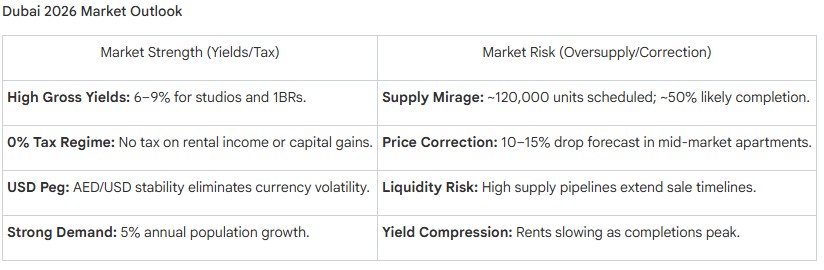
Dubai remains the "Conditional Buy" of the 2026 market, standing as a cynical contrast to the tax-heavy West. It offers 6–9% gross yields and a 0% tax environment on rental earnings. However, the "Supply Paradox" looms large.
Market trackers forecast 120,000 new units for 2026. While statistically, only about half of these (around 60,000) will actually materialize, the "Supply Mirage" is enough to trigger a 10–15% correction in the mid-market segment. For the strategist, the target is JVC or International City, but mid-market apartments are currently a high-risk "Correction Zone."
Dubai 2026 Market Outlook
5. The Bahamas: A $2 Billion Infrastructure Gamble
Freeport, Grand Bahama, is currently a speculative recovery play masquerading as a safe haven. The market has endured 20 years of stagnation, triggered by the Royal Oasis closure in 2004 and subsequent hurricane damage. Today, a $2 billion pipeline (Carnival Port, Airport expansion, Shipyard) has sparked a "25% surge" in activity.
But beware the "late-cycle momentum trap." The margin of safety is razor-thin:
- The Occupancy Trap: The break-even occupancy rate is a daunting 83.4%.
- The Yield Floor: Cash-on-cash returns sit at a pathetic 0.87%. There is no buffer for the inevitable maintenance emergencies of a coastal environment.
- The Storm Tax: Hurricane risk remains the ultimate market disruptor.
"Single major storm can freeze market for years (see Abaco 2019-2024)."
For the 2026 investor, Freeport is a bet on infrastructure execution in a region where economic growth is anemic (1.1%) and a single weather event can evaporate liquidity for five years.
6. Conclusion: The Rise of the "Anti-Foreign Buyer" Era
The overarching theme of 2026 is the death of the welcomed non-resident. From Toronto’s 35% tax penalty and federal ban to Spain’s proposed 100% tax hike and the Bahamas raising its residency threshold to $1 million, the message is clear: the lifestyle benefit of a foreign home now carries a lethal opportunity cost.
The math is unforgiving. An investor in Toronto today is looking at a -5.3% five-year IRR. Meanwhile, risk-free assets like US Treasuries offer a +25% cumulative five-year return. That is a 30% gap in total wealth—a difference of roughly $200,000 USD on a $500,000 investment.
In the "Anti-Foreign Buyer" era, you must decide if the view is worth the wealth destruction. Before you wire your deposit, ask yourself the only question that matters: Are you buying an investment, or are you paying for a postcard?
For more details and in-depth real estate analysis for this city, visit the www.under500k.ai website.
Written by
Under500K Team
Research and market insights for global property investors.