Learn how a $450K entry point in Nassau gives non-resident investors 0% income and exit tax, solid monthly cash flow, and upside in a recovering Bahamas realestate market
For the discerning global capital allocator, the Bahamas has traditionally represented a high-barrier, ultra-luxury enclave—a destination where a seat at the table required seven-figure liquidity. However, a "thoughtful synthesis" of current market data reveals a compelling divergence from this narrative. A strategic window has opened in Nassau, offering an entry point at $450,000. This is no longer merely a playground for the billionaire class; it has transitioned into a sophisticated "Recovery" phase opportunity for investors seeking to move away from high-tax, volatile mainland jurisdictions. By focusing on professional-grade financial metrics rather than just tropical aesthetics, we see a market re-emerging as a powerhouse for tax-efficient income and stable, dollar-pegged growth.
The "Invisible" Tax Advantage
The Bahamian investment thesis is anchored in a fiscal environment that prioritizes long-term wealth preservation. While the initial capital outlay includes a 10% Purchase Tax—contributing to a Total Acquisition Cost of $510,000—the true genius of the play lies in the subsequent "frictionless" compounding. For foreign and non-resident investors, the Bahamas offers a 0% Income Tax and 0% Exit Tax structure.
In a fintech context, this fundamentally alters the internal rate of return (IRR) math compared to mainland jurisdictions. When an investor avoids the annual erosion of rental income by a 20-30% tax bracket, the effective yield compounds at a significantly higher velocity. The 10% entry fee is a one-time hurdle; the 0% exit tax ensures that 100% of the capital appreciation remains in the investor's portfolio upon divestment.
Tax Metrics & Acquisition Costs
- Entry Price: $450,000
- Total Acquisition Cost: $510,000
- Income Tax: 0%
- Exit Tax: 0%
Catching the "Recovery" Wave
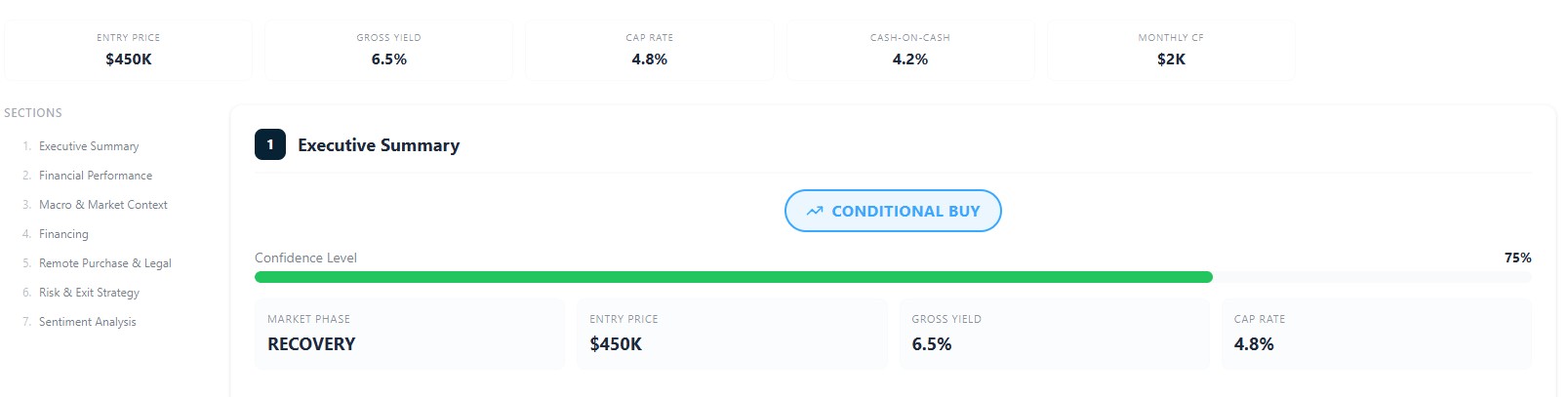
Timing is the ultimate arbiter of success in real estate, and Nassau is currently flashing a "Conditional Buy" signal with a 75% confidence level. The market is officially in a Recovery phase, supported by a Sentiment Score of 65. This phase represents the optimal entry point: prices have stabilized, and the 12-month forecast predicts a steady 3% appreciation.
In real estate cycles, the "Market Cycle Phase" identifies the transition from recessionary lows toward the expansionary peak. Entering during a recovery allows an investor to capture the "alpha" of the upcoming expansion without the extreme risk profile of a distressed market. With a positive outlook and quantitative backing, this phase offers a margin of safety that is often absent in overheated, peak-cycle markets.
Significant Monthly Cash Flow for the Price Point
The financial performance of this 450,000 entry point is remarkably robust. The property yields a consistent 2,000 in monthly cash flow, or $22,000 annually. From a strategist’s perspective, the importance lies in the spread between the **6.5% Gross Yield **and the 4.8% Cap Rate.
Even more impressive is the 4.2% Cash-on-Cash return. In an era of high interest rates, finding an asset that maintains a positive cash-on-cash yield after accounting for all operating expenses and financing is increasingly rare. It demonstrates that the Bahamian market isn't just a speculative land play; it is a high-functioning income asset that provides immediate liquidity.
Monthly Cash Flow: $2,000 | Gross Yield: 6.5% Cap Rate: 4.8% | Cash-on-Cash: 4.2%
Currency Stability as a Hidden Safety Net
The macro-economic backdrop of the Bahamas provides a "de-risking" layer that is often overlooked. The Bahamian dollar is pegged 1:1 to the U.S. Dollar, effectively eliminating currency risk for USD-based investors. This parity is bolstered by a low 1% inflation rate and a steady 2.1% GDP growth rate.
While the investment carries a "Medium Risk" rating, this risk is quantified and manageable. The data indicates a 3-year break-even period and a maximum potential loss of 20%. For a strategist, this transparency is vital. The currency peg ensures that the $2,000 monthly cash flow retains its purchasing power, acting as a hedge against the volatility often found in other emerging Caribbean or Latin American markets.
The Verdict: A 5-Year Horizon
 The optimal exit strategy for this play is a 5-year horizon, a timeline that aligns perfectly with the transition from recovery to expansion. By utilizing a 65% Max LTV mortgage at a 6.75% rate, investors can achieve a Leveraged IRR of 8.1%. Given the 3-year break-even point, the final two years of the hold period represent pure capital optimization.
As global fiscal policy remains unpredictable, the question is no longer about whether to diversify, but where. Is your current portfolio protected by 0% income tax and a 1:1 USD peg, or is it time to consider the $450K gateway into the Bahamian recovery?
For more details and in-depth real estate analysis for this city, visit the www.under500k.ai website.
Written by
Under500K Team
Research and market insights for global property investors.