Discover why Milan leads on growth, Rome offers post-Jubilee stability, and Turin delivers the best value for-money in Italy’s 2026 real estate market.
The romantic pull of the Italian villa—an enduring tableau of cypress-lined drives and the unhurried grace of la dolce vita—remains a potent force in the global imagination. Yet, as we progress through 2026, the Italian property market has undergone a fundamental structural pivot. It has transitioned from a post-pandemic recovery narrative into an intense acceleration phase, characterized by institutionalized demand and a regulatory landscape that is increasingly professionalized. For the global strategist, Italy currently offers an intriguing paradox: deep liquidity and sophisticated tax incentives for high-net-worth migration, contrasted with a bureaucratic framework that is increasingly unforgiving to the uninitiated.
The Residency Fallacy: De-risking the "Golden Visa" Assumption
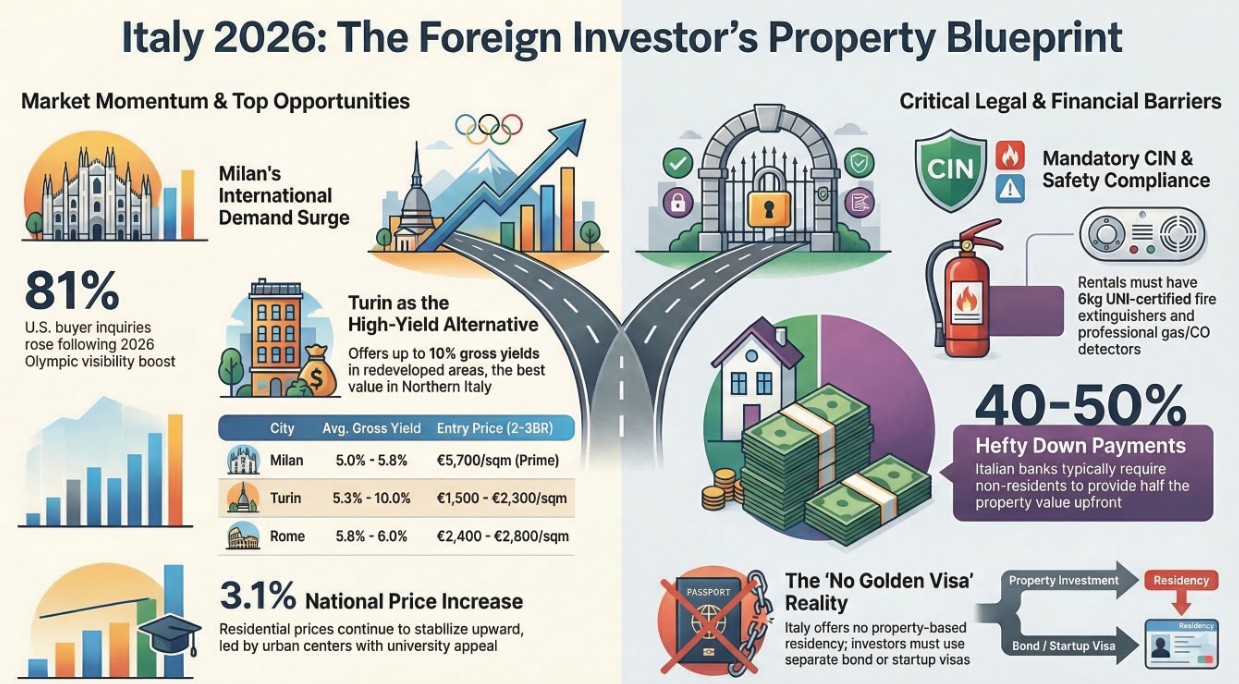
One of the most persistent assumptions among international buyers is that a significant real estate acquisition serves as a de facto gateway to European residency. However, the Italian framework is notably distinct from the property-based "Golden Visa" shortcuts historically favored by Greece, Spain, or Portugal.
This was a deliberate political and economic choice codified in the 2017 Budget Law (Law 232/2016). Italian lawmakers intentionally decoupled property ownership from residency to avoid the localized price distortions and speculative bubbles seen in neighboring Mediterranean markets. Instead, the "Investor Visa for Italy" remains strictly tethered to productive capital: €250,000 in innovative startups, €500,000 in limited companies, or €2 million in government bonds.
"In this context, Italy’s approach now appears countercurrent only at first glance... this strategy has proven consistent with the evolution of European recommendations, sparing Italy from subsequent corrective interventions and strengthening the legal sustainability of the program." — Impatria
For those seeking a purely lifestyle-driven relocation, the pathways are narrow. While the Elective Residence Visa suits those with substantial passive income, investors must recognize that property ownership is a consequence of relocation, not the mechanism for it.
The Olympic Discovery Engine: A Credibility Accelerator
As Milan prepares for the 2026 Winter Olympics, the city has become a "discovery engine" for global capital. While such events often provide a temporary "sugar high" in secondary markets, the long-term impact on Milan has been a "credibility accelerator." According to Marina Rizzotto Yakovleva, CEO of Berkshire Hathaway HomeServices Palazzo Estate Italy, international clients often discover a territory during these global windows but only return as buyers once they have processed the underlying market fundamentals.
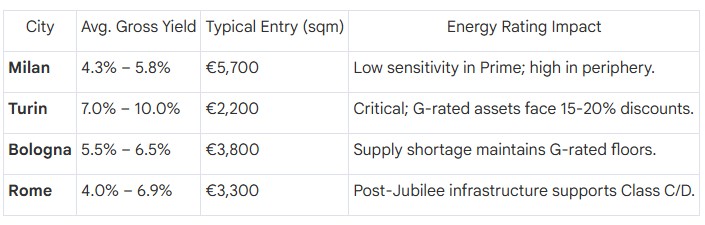
The data confirms a structural shift. In late 2025, inquiry growth traced a "hockey-stick" curve, with demand from the United Kingdom surging by 160% and U.S. interest rising by 81%. This is not mere speculation; Milan now ranks No. 7 globally among individual cities and No. 16 in the overall JamesEdition Global Prime Market Index. This institutionalization of demand has pushed prime prices to approximately €5,700 per square meter, outperforming established capitals like Paris and Rome in terms of demand momentum.
The 15.9% Round-Trip and the 50% Equity Threshold
Investors accustomed to the high-leverage environments of the US or UK often encounter a sobering reality when dealing with Italian lenders. The banking sector remains fundamentally conservative, particularly regarding non-resident income. International buyers should anticipate a standard 40% to 50% down payment requirement.
However, the down payment is only the beginning of the capital commitment. A sophisticated investor must account for the "round-trip" transaction costs, which typically reach approximately 15.9% for a €300,000 purchase. This includes a 9% Registration Tax (for non-residents), 3% plus VAT for agency commissions, and approximately 1.5% for notary and legal fees.
"The real signal is not how fast the market is growing, but what is driving it... Prices have stayed disciplined and in line with Milan’s position among Europe’s leading city markets." — Eric Finnas Dahlstrom, CEO of JamesEdition
The CIN System: The Professionalization of DIY Hospitality
For those viewing Italian property as a yield-bearing asset through short-term rentals, 2026 marks the end of the "hobbyist" era. The mandatory national CIN (Codice Identificativo Nazionale) system and the centralized BDSR database are now fully operational. Operating without a CIN, or even failing to display it on an Airbnb listing, carries a financial penalty of up to €8,000.
More critically, the regulatory focus has shifted to certified safety. "DIY" safety installations are now a significant legal liability. All equipment must be installed and certified by tecnici abilitati (licensed professionals) to pass inspection.
2026 Mandatory Safety Specifications:
- Fire Extinguishers: Minimum 6kg capacity with UNI 9994-1 certification; one per floor and one per 200sqm.
- Gas Detection: Certified combustible gas and carbon monoxide detectors with an audible alarm of at least 85 decibels.
- Electrical Compliance: DM 37/2008 certifications must be verified and renewed biennially.
Yield Arbitrage and the Energy Efficiency Risk
As Milan’s net yields compress toward 3.6%, investors are seeking arbitrage in secondary hubs. However, the 2026 market is increasingly defined by the European "Green Homes Directive." This has created a bifurcated market: Class A and B properties are highly liquid and sell at a premium, while Class G and F properties face significant downward pressure. In 2026, savvy buyers calculate the "mandatory renovation cost" required to meet efficiency standards and subtract it directly from their offers.
Turin remains the "best value for money" in Northern Italy, particularly for those targeting the student and young professional demographic. The Aurora (Barriera di Milano) neighborhood has emerged as a prime gentrification play, offering gross yields between 7% and 10% in areas benefiting from the new Metro Line 2 infrastructure.
The "Early Binding" Trap: Pre-Contractual Liability
In Anglo-American law, the "exchange of contracts" provides a clear, late-stage binding moment. In Italy, the legal trap is that commitment occurs much earlier. Once a Proposta d’Acquisto (Purchase Proposal) is accepted, or the Compromesso (Preliminary Contract) is signed, the deal is legally final.
Most contracts utilize a caparra confirmatoria. If the buyer defaults, the deposit is forfeited; if the seller withdraws, they must pay the buyer double the deposit amount. "The Italian Lawyer" warns of common "€10,000+ mistakes" where foreign buyers treat early documents as mere "expressions of interest." It is also essential to note that the Notary is a public officer and a neutral party—they ensure the legality of the transaction, but they do not act as a private advocate for the buyer’s financial interests.
Conclusion: The Selective Asset Era
The Italian market of 2026 is no longer a simple recovery story; it is a mature, selective landscape that rewards forensic due diligence. The incentives for high-net-worth individuals remain world-class, including the recently updated €300,000 flat tax on foreign income for new residents and a specific 7% flat tax for retirees relocating to smaller southern municipalities (under 20,000 inhabitants).
However, the "Green Homes Directive" and the professionalization of the rental sector mean that passive ownership is becoming increasingly complex. Investors must ultimately ask whether they are pursuing a lifestyle trophy or a strategic, high-performance asset. In 2026, the Italian regulatory framework unequivocally favors the latter, rewarding those who prioritize legal clarity and technical compliance over the romanticism of the past.
Written by
Under500K Team
Research and market insights for global property investors.