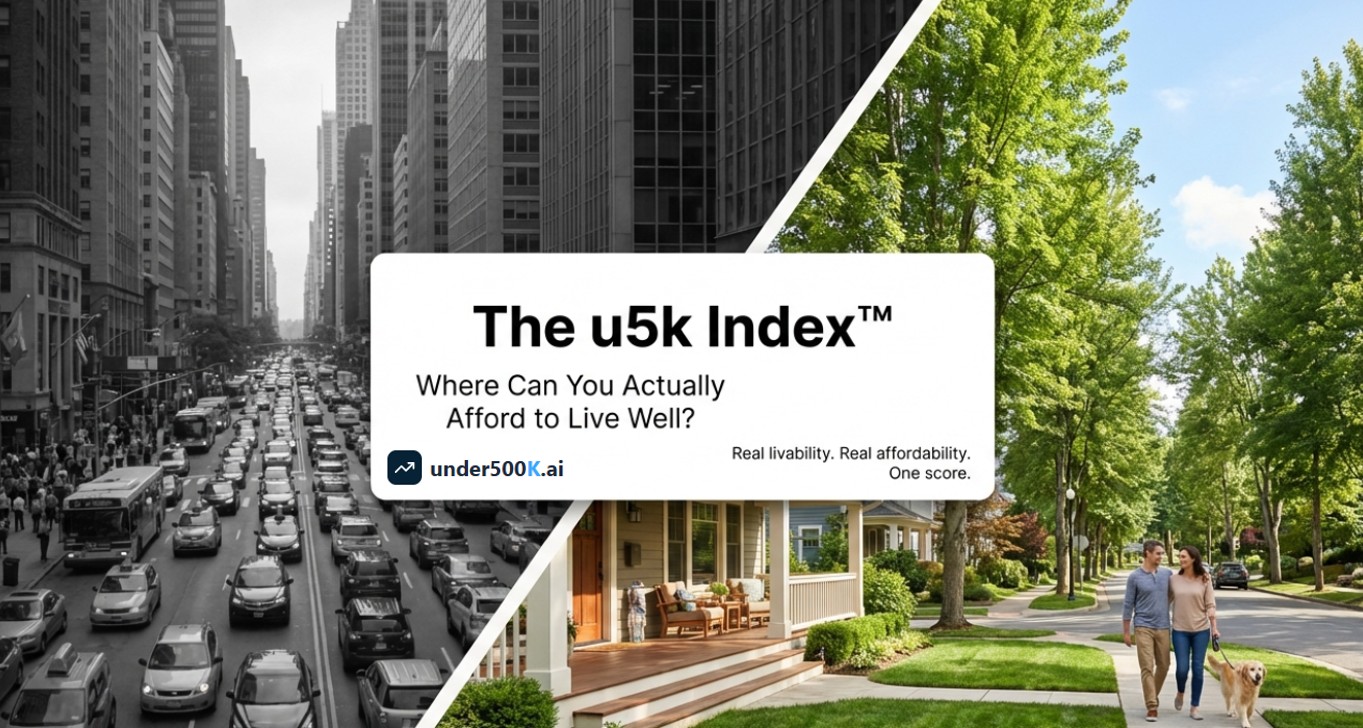
Discover how the u5k Livability Index™ filters out unaffordable metros and scores under-$500K cities on 10 livability dimensions.
The San Francisco Trap
Every year, glossy real estate rankings promise a "top-tier" quality of life, usually by spotlighting the same handful of coastal giants: San Francisco, Manhattan, or Seattle. But for the average professional, these lists are less of a guide and more of a taunt. When the "barrier to entry" for a basic starter home sits at a staggering $1.5 million, the amenities of the city become irrelevant. You aren't buying a lifestyle; you’re buying a lifetime of debt.
As a strategist, I’ve seen how market volatility and skyrocketing prices have rendered traditional rankings obsolete. We need a data-driven pivot. Enter the u5k Livability Index™, the "livability index for the rest of us." It is designed to silence the distractions of prestige and focus on a single, uncompromising thesis: Quality of life is meaningless without affordability.
The "Unaffordable Noise" Filter
The u5k Livability Index™ operates on a radical filter: it only considers markets where the median home price is under $500,000. While traditional platforms measure cities "as they are," often ignoring the financial reality of the viewer, the u5k Livability Index™ measures cities "as they are for you."
For first-time buyers and young families, this isn't just a preference—it’s a necessity. By stripping away the high-priced outliers, we can actually see the map of opportunity that remains. It allows us to stop looking at cities we can’t afford and start looking at options where a future doesn't require winning the lottery.
"What good is a 'great city' if you can't afford to live there?"
Livability is More Than Just a Low Price Tag
A low price tag is only half the equation; "affordable" shouldn't mean "cheap" or "lacking amenities." The u5k Index™ uses a rigorous 0–100 scoring system based on 10 dimensions of everyday life, ensuring that a high score represents a truly high-quality environment:
- Housing Affordability: Price-to-income ratios, mortgage burdens, and rent vs. buy analysis.
- Purchasing Power: A measure of how far your local dollar actually stretches.
- Healthcare Access: Quality of care, availability, and insurance costs.
- Education Quality: Schools, universities, and opportunities for lifelong learning.
- Commute & Mobility: Traffic patterns, transit options, and remote work friendliness.
- Environment: Air quality, green space availability, and climate comfort.
- Safety: Evaluation of crime trends, community security, political instability, wars.
- Lifestyle & Culture: Local dining, entertainment, and the general "vibe."
- Economic Resilience & Future Proofing: Industry diversity, retail vibrancy, and job market health.
- Social Inclusion & Diversity: Tolerance and inclusivity, accessibility for people with disabilities, multilingual services, and support for seniors.
This methodology is designed for "future-proofing." For instance, Economic Resilience isn't just about today’s unemployment rate; it’s about industry diversity that prevents a city from collapsing if one sector fails. Similarly, the Social Inclusion dimension proves the index’s depth by moving beyond general "vibes" to track specific metrics like senior support and disability access, ensuring long-term community stability.
AI vs. Anecdotes: Why Data Freshness Matters
Traditional platforms like Numbeo have long been the standard, but they suffer from a fundamental flaw: they rely on user-submitted anecdotes and periodic updates. In a volatile market, user "feelings" are no substitute for hard facts.
The u5k Livability Index™ serves as a disruptor by utilizing AI-aggregated and verified data with monthly updates. Traditional indexes tell you how a city used to be; u5k tells you what it is right now. This is the difference between measuring a city "as it is" versus "as it is for you." Markets shift rapidly, and your relocation strategy shouldn't be based on stale data.
The "Priority Matcher": Personalizing the Search
Because "livability" is ultimately subjective, the index includes a Priority Matcher. This tool allows you to weight the dimensions that align with your specific life stage, whether you're an early retiree or a digital nomad. You can filter for:
- Best schools for my kids
- Lowest cost of living
- Outdoor recreation access
- Shortest commute times
- Best healthcare nearby
- Warmest climate
- Most vibrant culture
- High-speed Internet connectivity
Conclusion: Finding the Sweet Spot
Life is too short to live in a city that drains your bank account, but it’s also too short to live somewhere you hate just because it’s cheap. The goal is to find the "sweet spot"—that precise intersection where affordability meets quality of life.
Take a hard look at your current zip code. Is your city actually serving your future, or are you just paying a premium for "unaffordable noise"? By ignoring the prestige trap and following the data, you can stop chasing someone else's "best city" and start building a life in a home you can actually afford to enjoy.
Written by
Under500K Team
Research and market insights for global property investors.