
In-depth January 2026 analysis of Barcelona, Madrid, Malaga, Valencia, Seville, Bilbao, San Sebastian, and Zaragoza for sub-$500K long-term rental investors.
Executive Summary
This briefing document provides a comprehensive synthesis of real estate investment viability across eight primary Spanish markets: Barcelona, Bilbao, Madrid, Malaga, San Sebastian, Seville, Valencia, and Zaragoza. As of January 2026, the Spanish residential market is largely characterized by a recovery or expansion phase, driven by significant supply shortages and robust demand from expats, professionals, and the tourism sector.
Key Takeaways:
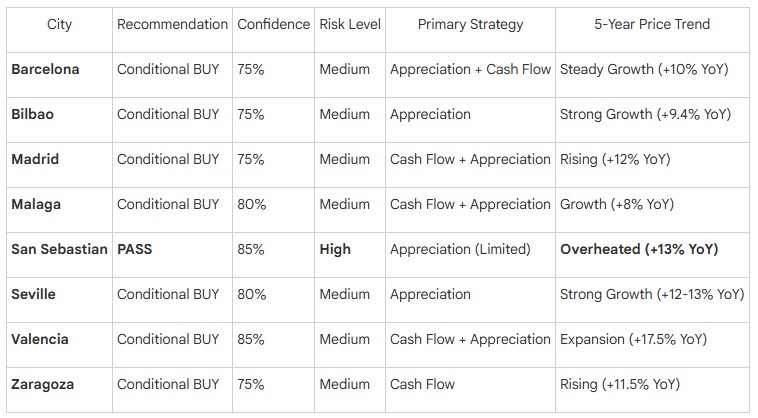
- Investment Sentiment: Most markets receive a "Conditional Buy" recommendation with confidence levels between 75% and 85%. San Sebastian is the notable exception, with a "PASS" recommendation due to peak pricing and high risk of correction.
- Yield Dynamics: Gross yields generally range from 3.5% to 7%. Peripheral neighborhoods in secondary cities like Zaragoza and specific districts in Malaga and Valencia offer the highest cash-flow potential.
- Regulatory Risks: Strict rental regulations and the phasing out of short-term rental (STR) licenses in major hubs (Barcelona, Madrid) necessitate a strategic pivot toward long-term rentals (LTR) targeting expats and professionals.
- Financing and Taxation: Non-resident investors face a standard 24% income tax on gross or net rentals and typically require 30–40% down payments for mortgages (60–70% LTV). The "Golden Visa" program for real estate investment has been phased out or abolished across all analyzed regions as of 2024–2025.
- Operational Feasibility: All markets score high (8/10 or 9/10) for remote purchase feasibility, supported by digital notarization and the standard use of Power of Attorney (POA).
Comparative Market Sentiment and Recommendations
The following table summarizes the investment stance and core metrics across the analyzed cities.
Detailed City Analysis
1. Barcelona
Barcelona remains a vibrant Mediterranean hub but is significantly strained by housing shortages and strict rental regulations.
- Optimal Neighborhoods: Nou Barris (Tier 1: 6–7% yield) and Sants (Tier 2: 5.5–6.5% yield).
- Financials: Net yields hover around 3.9%, with an expected leveraged IRR of 9.2%.
- Risk Note: STR is considered unviable due to the phasing out of short-term licenses. Investors should focus on the stable LTR demand from expats, who represent 40% of the tenant market.
2. Bilbao
Bilbao's market is driven by the economic strength of the Basque Country and low local unemployment (7.5%).
- Optimal Neighborhoods: Santutxu/Begoña (5% yield) and Deusto (4.7% yield).
- Financials: The market shows strong price growth (+9.42% YoY), but gross yields (~4.7%) are low, making leveraged scenarios potentially negative for non-residents.
- Verdict: Suitable for long-term holds and capital appreciation rather than immediate cash flow.
3. Madrid
As Europe's fastest-growing major city, Madrid suffers from a 91,000-home deficit, supporting high demand.
- Optimal Neighborhoods: Puente de Vallecas (Tier 1: 6–7% yield) and Carabanchel (Tier 2: 5–6% yield).
- Financials: Offers a 3% cap rate and 9.2% leveraged IRR.
- Regulatory Context: Tightening rental regulations and the end of the Golden Visa are key risks; long-term expat leases are recommended to mitigate STR bans.
4. Malaga
Malaga is experiencing a tech and tourism boom, with the highest sentiment score (85/100) among analyzed cities.
- Optimal Neighborhoods: Ciudad Jardín (6.7% yield) and Churriana (6% yield).
- Financials: Boasts high leveraged IRR (12%) and steady 7–10% price growth forecasts.
- Demand: Driven by a tourism surge and remote workers; rents rose 10% YoY.
5. San Sebastian
The only market recommended as a "PASS."
- Rationale: Prices are at historic highs (~6,450 EUR/m²). The market is in a peak phase with extremely low net cash-on-cash returns (0.5%).
- Financials: Net yields are as low as 1.8%, and the risk of a market correction is high. Taxes and entry costs outweigh limited appreciation potential.
6. Seville
Seville is benefiting from infrastructure upgrades (Metro Line 3) and strong tourism growth.
- Optimal Neighborhoods: Macarena/Pino Montano (5.5–6.5% yield) and Triana/Nervion (4.5–5.5% yield).
- Financials: Leveraged IRR is strong at 12%. Listings in Andalusia have dropped by 27%, creating a supply-side push on prices.
- Strategy: Focus on long-term professionals and students.
7. Valencia
Valencia is in an expansionary phase, offering a cheaper alternative to Barcelona and Madrid with superior yields.
- Optimal Neighborhoods: Ruzafa (Tier 1: 7–10% yield) and Malvarrosa (Tier 2: 5–7% yield).
- Financials: City prices rose 17.5% YoY in Q4 2025. It offers a 9.2% leveraged IRR.
- Remote Score: Highest remote feasibility score (9/10).
8. Zaragoza
A logistics and industrial hub (Amazon, Opel), Zaragoza offers stability over high-speed appreciation.
- Optimal Neighborhoods: Delicias/La Almozara (7% yield) and Actur (6.5% yield).
- Financials: Leveraged IRR of 11% and high vacancy demand (34 contacts per listing).
- Investor Profile: Best suited for conservative investors seeking exposure to the European market with low entry prices ($280k average).
Financial and Regulatory Framework
Acquisition Costs
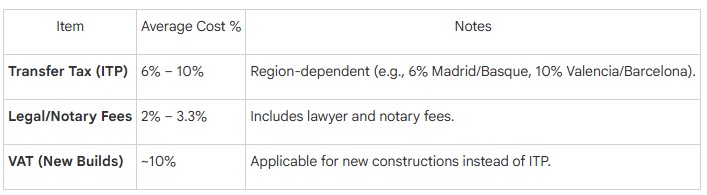
Investment in Spain requires significant upfront capital beyond the purchase price. Effective entry costs typically range from 107.5% to 116% of the purchase price.
Taxation for Non-Resident Investors
- Rental Income Tax (IRNR): 24% for non-EU residents.
- Capital Gains Tax (CGT): Ranges from 19% to 26% upon exit.
- Property Tax (IBI): Annual tax ranging from 0.3% to 0.6% of the cadastral value.
Financing for Foreigners
Mortgages are available but limited compared to resident terms:
- Maximum LTV: 60% – 70%.
- Interest Rates: 2.5% – 5% (fixed and variable options).
- Requirements: NIE (Foreigner Identification Number), passport, and proof of income (typically minimum €2,500/mo).
Remote Investment Logistics
Spain facilitates remote acquisition for foreign investors through established legal mechanisms.
- Power of Attorney (POA): The standard method for remote transactions. A local lawyer or representative can sign deeds and manage the purchase.
- Digital Capabilities: Digital notarization is partially allowed; title and deed transfers are managed via digital registries.
- Property Management (PM): High availability across all cities. Fees range from 6% to 15% of gross rent for long-term rentals and up to 25% for short-term/managed services.
Risk Assessment and Exit Strategies
Critical Risks
-
Regulatory Volatility: New rental caps and the phasing out of STR licenses (especially in Barcelona and Madrid) can impact yields.
-
Currency Mismatch: Foreign investors earning in USD while holding EUR-denominated debt face FX risk.
-
Negative Leverage: In markets like Bilbao or San Sebastian, mortgage rates may exceed net cap rates, leading to negative monthly cash flow.
##Exit Strategy Analysis
- Optimal Hold Period: 5 years is the recommended "Base Case" for most markets to maximize appreciation while balancing CGT.
- Market Liquidity: High across most urban hubs, with an average of 60–90 days on market (DOM).
- Tax Optimization: Holding for more than one year can sometimes reduce CGT liability; selling via a company structure is an alternative for large portfolios.
Infrastructure and Amenities
International Schools
For expat-focused rentals, proximity to international schools is a major demand driver.
- Barcelona/Madrid: Offer the most expensive and prestigious options (e.g., American School of Barcelona, $20-25k tuition).
- Valencia/Malaga: Offer high-quality British and American curricula at slightly lower price points ($9-20k).
Healthcare System
Spain's healthcare is rated "Excellent" globally.
- Accessibility: Private hospitals (Quironsalud, Teknon) widely offer English-speaking services.
- Costs: Private health insurance for expats ranges from €1,000 to €4,000 annually, depending on coverage levels.
Written by
Under500K Team
Research and market insights for global property investors.