
Here is what foreign investors need to know to successfully navigate Portugal’s real estate market in 2026.
For decades, the international perception of Portugal has remained remarkably consistent: a "hidden gem" of Western Europe offering sun-drenched retirements, a Mediterranean lifestyle, and a famously low-tax environment. This narrative fueled a historic property boom and a wave of foreign relocation. However, as we enter 2026, the landscape has fundamentally shifted. The market has reached a state of maturity where "winging it" is no longer a viable strategy. With rising entry prices, complex new tax structures, and shifted residency requirements, the classic expat playbook has been rewritten. In a landscape of rising costs and high regulatory standards, where does the real opportunity lie? For the sophisticated global citizen, the answer is no longer found in sentiment, but in data.
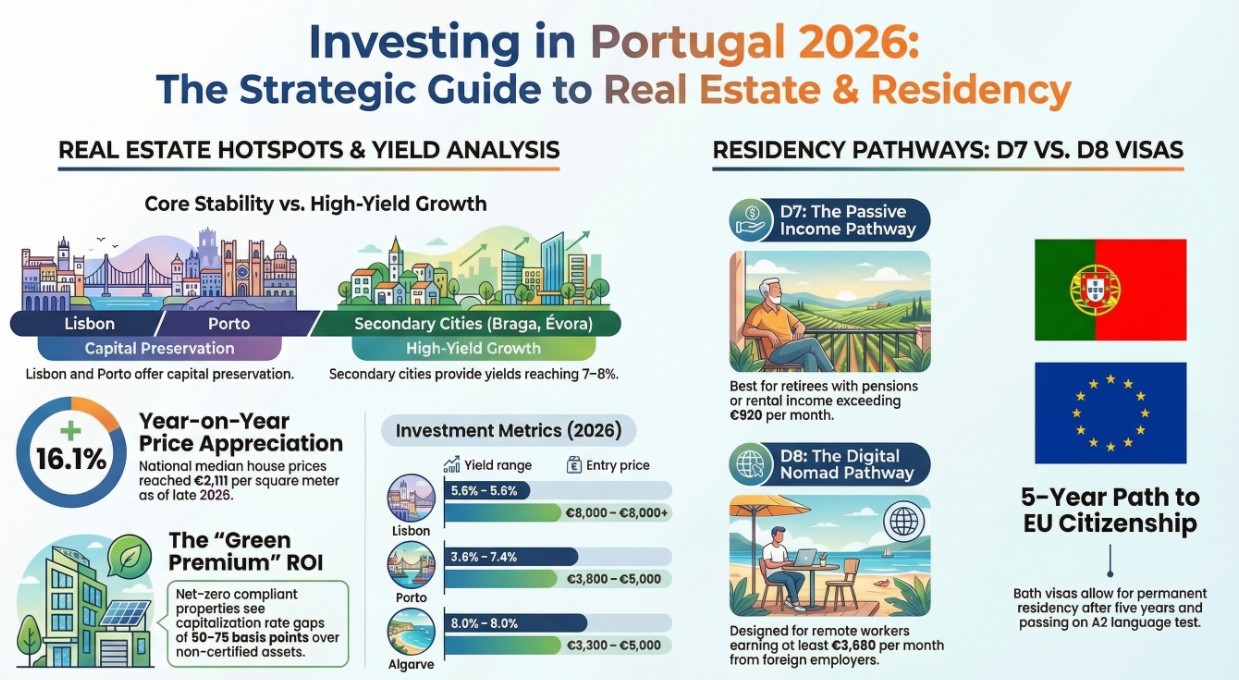
The Yield Migration to "Secondary" Stars
While Lisbon remains the "liquid core" of the Portuguese market, its primary function for high-net-worth investors in 2026 has shifted toward capital preservation. Prime residential prices in the capital now command between €4,000 and €6,000 per square meter, with long-term yields moderating to approximately 5% to 5.6%. Consequently, "smart money" is migrating toward secondary cities like Braga, Coimbra, and Viseu, where the entry-to-yield ratio is significantly more compelling.
Braga, often referred to as the "Rome of Portugal," has emerged as a dynamic tech and investment hub. With a younger demographic and a booming tech ecosystem, property prices remain attractive at €2,000 to €3,000 per square meter, while central areas are delivering yields near 7%. Similarly, the university city of Coimbra offers a defensive play with price points between €2,000 and €2,800 per square meter and yields reaching 7.9% in surrounding areas.
As Paul Stannard, chairman of Portugal Pathways, observes:
The market suits sophisticated investors wanting precision, diversification, and alignment with personal and financial goals, rather than those chasing the next property boom and, in doing so, flirting with risk.
The Massive "Income Gap" Between D7 and D8 Visas
A common point of confusion for those relocating in 2026 is the financial hurdle associated with different residency pathways. The 2026 income thresholds reveal a staggering four-fold gap: the D7 Visa (Passive Income) requires a minimum of €920 per month, while the D8 Visa (Digital Nomad) requires €3,680 per month.
For the Digital Nomad applicant, the barrier to entry is not merely monthly income; authorities now recommend a minimum savings buffer of €11,040 to secure approval. This means a remote worker faces significantly higher financial scrutiny than a retiree or landlord. For global citizens with "mixed income" profiles—combining remote work with investment dividends—careful categorization is essential. Failing to prove the specific active income required for the D8 or misapplying as a D7 can lead to immediate application rejection.
Portugal is No Longer a "Low-Tax Shortcut"
The era of Portugal serving as a blanket low-tax jurisdiction has ended. The original Non-Habitual Resident (NHR) regime is closed to new applicants. It has been replaced by the NHR 2.0 (IFICI), but this regime is extremely narrow. It is specifically reserved for individuals in high-value sectors such as scientific research, tech innovation, start-ups, and specialized medical professions.
For the vast majority of new arrivals, standard Portuguese IRS bands now apply, with progressive rates reaching as high as 48%. This creates a significant "Misinformation Problem" for those relying on outdated commentary. Portugal is now a "structured jurisdiction," where effective tax planning requires a focus on income timing and portfolio repositioning.
Portugal is no longer a low-tax shortcut. It is a structured system. Without sequencing, you overpay.
The "Green Alpha" and the 2026 Carbon Stick
In 2026, sustainability has transitioned from a moral choice to a critical financial strategy. New EU sustainability standards have introduced a "Cap Rate Gap" of 50 to 75 basis points between Net-Zero compliant properties and "brown" assets.
Buildings with an 'A' energy rating are seeing yield compression and higher valuations, while carbon-heavy properties face "regulatory obsolescence." The most profitable play in the current market is the "Brown Discount" strategy: targeting 'D' or 'E' rated assets at a reduced price and utilizing local tax credits to upgrade them to 'A' status. This "Green Alpha" not only secures the asset against future property tax surcharges—which many municipalities are now tiering based on energy performance—but also maximizes long-term ROI in a carbon-conscious market.
The "Accidental Residency" Trap
One of the most dangerous pitfalls in the 2026 market is the "Habitual Residence" test. While many investors focus on the 183-day rule, residency can actually be triggered on Day One if you demonstrate the intention of making Portugal your habitual home.
Physical presence is not the only trigger; intent is the silent killer. Signing a long-term lease, purchasing a residence, or moving family members ahead of your own arrival can all lead to an "Accidental Residency" finding. For families, moving a spouse early to set up a household is often viewed by authorities as establishing your "centre of interests," potentially leading to taxation on your worldwide income before you have properly structured your exit from your home jurisdiction.
Summary
The "easy wins" and blanket tax incentives of the last decade have been replaced by a market defined by depth, variety, and complexity. Portugal remains one of Europe’s most compelling jurisdictions, but success in 2026 is reserved for those who are data-led and strategically aligned with the new regulatory reality.
In a market defined by data rather than sentiment, is your current strategy built for Portugal’s past, or its future?
Written by
Under500K Team
Research and market insights for global property investors.