
Lithuania’s 2026 economy is reshaped by tax reform, EURIBOR rate cuts, and an 83.6% surge in Vilnius home sales, creating a complex but strong investment climate.
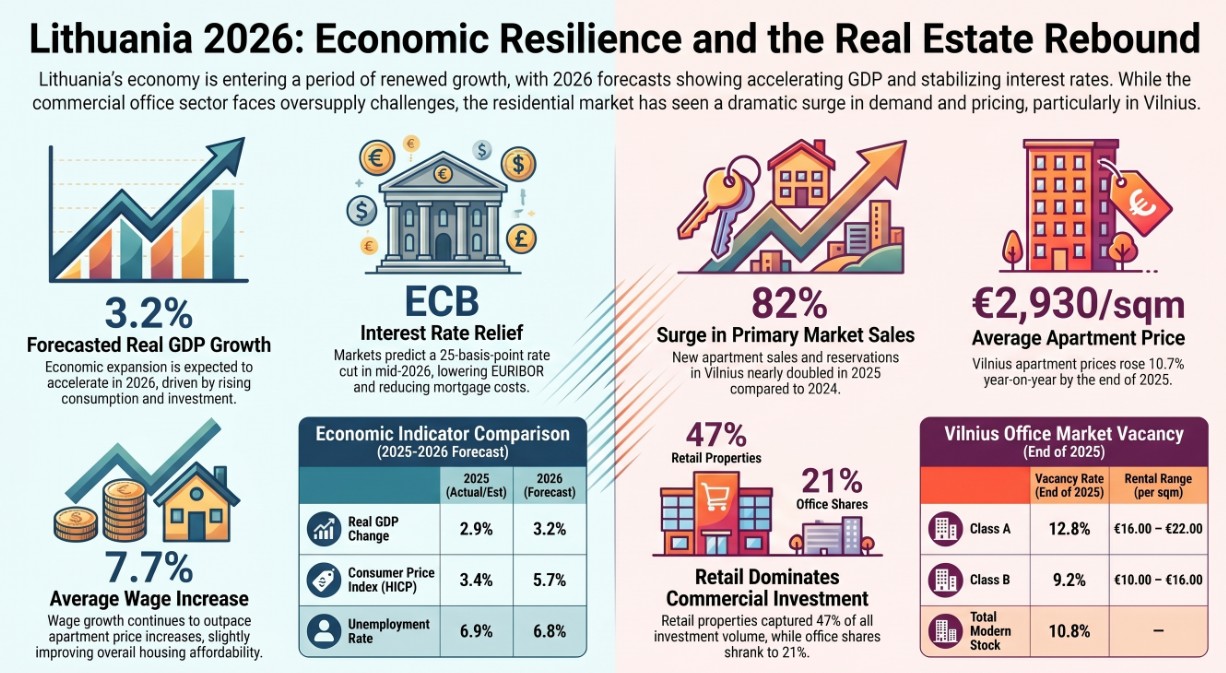
Lithuania enters 2026 in a state of high-velocity transformation. While much of the Eurozone is focused on a fragile stabilization, the Lithuanian economy—bolstered by a forecast real GDP growth of 3.2%—is navigating a complex "new reality." It is a year defined by the collision of massive tax overhauls, a skyline-altering construction boom, and a long-awaited shift in monetary policy.
For residents and investors alike, the 2026 landscape is markedly different than it was just two years ago. From the end of the "flat tax" era to the rise of local investment powerhouses, here are the five most impactful takeaways defining the Lithuanian economic and real estate landscape this year.
-
The Mortgage Relief Ripple Effect
The spring of 2026 has brought a pivotal shift for Lithuanian households, most of whom hold variable-rate mortgages tied to the EURIBOR. Following the European Central Bank (ECB) meetings on May 21 and June 18, 2026, markets have priced in consecutive 25-basis-point rate cuts as inflation finally stabilizes at the 2% target. While a 0.25% reduction might appear small on paper, its significance in the Lithuanian context is largely psychological, signaling the definitive end of the interest rate peak.
For an average mortgage of €150,000, these cuts translate to monthly savings of approximately €15–27. While these figures are modest, the cumulative annual relief and the resulting boost in borrowing capacity are driving a renewed wave of market participation.
"If a cut is confirmed, the EURIBOR curve is expected to shift further downward. Borrowers typically feel this change during their next scheduled interest rate review." — Lukas Adomaitis, Economic Analyst
-
The 83.6% Growth Paradox
Perhaps the most counter-intuitive trend of 2026 is the explosive demand for housing in the capital. Despite property prices rising faster than household incomes, Vilnius recorded a massive 83.6% increase in new home sales and reservations over the preceding year. This "growth paradox" is driven by the return of the "postponed buyer"—individuals who delayed purchases during the high-interest period of 2023–2024 and are now re-entering the market.
However, the real driver of this price surge is a severe supply-side crisis. According to Ober-Haus data, developers built only 2,787 apartments for sale in Vilnius in 2025—barely half of the volume needed to satisfy primary market demand. This scarcity has pushed price growth across the country at uneven rates:
- Vilnius: Prices rose by approximately 8%.
- Kaunas: Experienced a sharp spike of 18.4%.
- Klaipėda: Saw a notable increase of 13.2%.
-
The End of the Flat Tax Era
2026 marks a structural departure from Lithuania’s long-standing reputation as a tax haven for high earners. The 2026 Tax Reform has dismantled the previous flat-rate system, replacing it with a progressive Personal Income Tax (PIT) structure. Crucially, the reform now requires the "pooling" of all major types of income into a single calculation, effectively closing previous "tax optimization" silos.
The new progressive PIT thresholds are:
- 20% for income up to €83,000.
- 25% for income between €83,000 and €138,000.
- 32% for income exceeding €138,000.
Beyond personal income, the Corporate Income Tax (CIT) has risen to 17%, and a new 0.2% contribution to the Defence Fund has been levied on commercial property. When added to the new "sugar tax" on sweetened beverages and the increased CO2 fuel tax, it is clear that the fiscal burden is shifting toward broader social and national security priorities.
-
The Rise of the Local Powerhouse
A striking feature of the 2026 commercial real estate market is the absence of large-scale international capital. Global funds have grown cautious, largely due to perceived geopolitical risks associated with Lithuania’s borders with the Kaliningrad exclave and Belarus. In their absence, domestic investors have stepped in, now accounting for a record 86% of all transaction volume.
This shift has fundamentally changed the nature of market activity. According to the Ober-Haus 2026 Real Estate Market Report, the market is currently characterized by a high volume of smaller deals rather than "trophy" acquisitions.
"The average transaction size was among the lowest on record, falling below €8 million. This accurately reflects the current situation, where the investment market is essentially operating without large-scale international capital." — Ober-Haus Market Report
-
CBDs Are No Longer Just for Work
The heart of Vilnius is undergoing a conceptual shift from a "Central Business District" to a mixed-use community hub. This transition is best exemplified by the "HORIZONTAI" project on Konstitucijos Avenue. This €200 million development rejects the traditional model of isolated glass office towers in favor of the "15-minute city" concept, integrating 217 homes designed for urban professionals directly into the business hub.
The district features shared rooftop groves, community spaces, and active ground floors designed to "magnetize" the right bank of the Neris river.
"This project turns the page on Konstitucijos Avenue as merely a place to work or shop. We aim to deliver a benchmark for sustainable, convenient, community-minded, resource-efficient urban living." — Viktoras Zubrecovas, Head of Development at RELEVEN
Conclusion: A Look Toward the Horizon
As we navigate through 2026, the Lithuanian economy finds itself in a state of robust but cautious strength. While the 3.2% GDP growth forecast is encouraging, it is shadowed by "black swan" risks. As SEB economist Tadas Povilauskas warns, the outbreak of war in Iran and the resulting spike in energy prices could rapidly revise these optimistic projections.
The core tension of the year remains: the housing market is booming and interest rates are falling, yet the tax burden is rising and international capital is waiting on the sidelines. As interest rates fall but taxes rise, is the 2026 market a window of opportunity or a signal to proceed with extreme caution?
For additional details please check the full city report for Vilnius: https://www.under500k.ai/app/reports/vilnius-lithuania-20260520-124826
Written by
Under500K Team
Research and market insights for global property investors.