Can foreigners buy property in China in 2026? Learn how new SAFE foreign exchange reforms, the 1-year residency rule, and WFOE options impact your purchase.
Navigating the Chinese property market has long been compared to scaling a "Great Wall" of bureaucracy. For decades, international buyers have been met with a complex web of city-level regulations and tight capital controls. Central to this complexity is the government’s unwavering core philosophy: "Property is for living in, not for speculation."
However, 2026 marks a pivotal era—a "Deep Reset" for the sector. Following a series of landmark reforms, the landscape for foreign buyers has shifted from a desperate state of "restoring stability" to a more calculated phase of "stabilizing" the market. As a global strategist, I have observed that while the red tape remains, the rules of engagement are more transparent than ever before.
-
Resolution of Procedural Conflicts in Capital Settlement
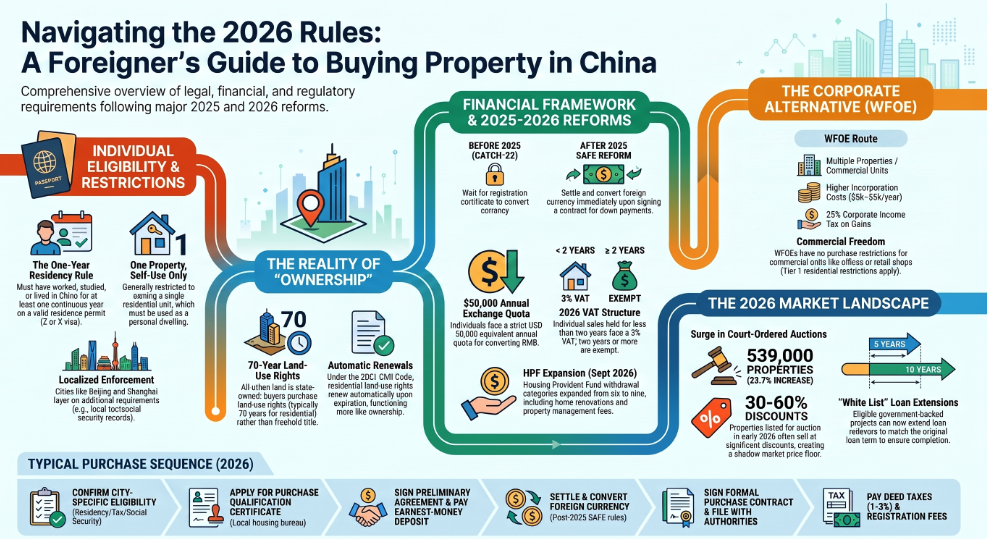
Prior to the September 2025 State Administration of Foreign Exchange (SAFE) reform, foreign buyers were trapped in a procedural "Catch-22." To legally pay for a home, you needed a registration certificate; however, the real estate bureau typically wouldn't issue that certificate until the seller confirmed receipt of the down payment. This "chicken-and-egg" dilemma forced many into high-risk informal payment channels.
The 2025 SAFE Notice dismantled this friction. A nationwide "pre-settlement" policy now allows qualified foreign buyers to settle and pay foreign currency using only a signed and filed purchase contract.
"Foreign individuals who meet the qualification requirements set by real estate regulators and local authorities may complete foreign exchange settlement and payment for property purchases at banks with a purchase contract or agreement, even before obtaining the official purchase registration certificate from the real estate regulator." — Dacheng Shanghai
This procedural shift significantly reduces the administrative stress of the closing process, transforming a historically opaque transaction into a linear, bank-led sequence.
-
You Own the Home, Not the Dirt: The 70-Year Reality
One of the most persistent shocks for Western buyers is that private land ownership does not exist in the People's Republic. All urban land is state-owned. When you "buy" a property, you are actually acquiring land-use rights for a fixed term.
- Residential Term: 70 years.
- Commercial Term: 40 years.
While the term "leasehold" implies a temporary stay, the 2021 Civil Code provides for the automatic renewal of residential land-use rights upon expiration. In practice, this functions closer to freehold ownership than many expect. However, as a regulatory analyst, I must warn that the "remaining term" is a critical valuation metric. A property with only 30 or 40 years left on its land grant may face lower liquidity, as renewal fees and specific conditions for every scenario are not yet fully standardized.
-
The "One-Year, One-Home" Rule: Eligibility and the WFOE Trap
Despite recent easing, individual eligibility remains strictly gated by the framework of Decree 171. If you are buying as a foreign individual, you must meet a non-negotiable threshold of residency:
- Continuous Residency: You must have lived, worked, or studied in China for at least one year on a valid residence permit.
- Single-Unit Limit: You are restricted to one residential unit nationwide.
- Self-Use Declaration: You must sign a written declaration that the home is for personal use, explicitly prohibiting rental income.
Some investors attempt to bypass these limits by using a Wholly Foreign-Owned Enterprise (WFOE). While this allows for multiple units and commercial holdings, it is a high-friction path. Maintenance costs range from $2,000 to $5,000 annually to cover mandatory accounting, tax filings, and legal address fees. Furthermore, banks rarely provide mortgages to these corporate entities without an extensive local operating history, making it a cash-heavy endeavor.
-
The Repatriation Boss Fight: Managing the Exit Strategy
In the Chinese market, the primary challenge is not the acquisition, but the eventual repatriation of proceeds. China maintains a $50,000 annual individual foreign exchange quota, and at the start of 2026, regulators implemented even stricter "Know Your Customer" (KYC) checks on outbound transfers.
To navigate this "boss fight," you must maintain a meticulous audit trail from day one. To move sale proceeds out of the country, banks will demand the following specific documents:
- The Original Registration Certificate: Proving the legal inception of ownership.
- The Filed Purchase Contract: Validating the original purchase price.
- Passport & Valid Residence Permit: Confirming your eligibility at the time of purchase.
- Labor Contracts and Work Visas: Providing evidence of the legal residency required for the initial buy.
- Tax Clearance Certificates: Evidence that all duties have been paid. Notably, under 2026 rules, properties held for two years or more are fully exempt from VAT, while those sold earlier incur a 3% VAT rate.
-
Shadow Prices: The 2026 Court-Auction Flood
The current market climate is defined by a "two-speed" reality. While Tier 1 cities like Shanghai are showing signs of a 4% recovery, a surge in court-ordered auctions is creating a psychological floor for the rest of the country. In the first seven months of 2026, auction listings reached 539,000 units—a 23.7% year-on-year increase.
These distressed properties often sell for 30% to 60% below secondary market rates. However, with a national clearance rate of only 36.2%, it is clear that "paper value" is being discarded in favor of raw liquidity.
"China has recalibrated its policy stance toward the country’s embattled property sector this year, shifting the emphasis from halting the market’s slide and restoring stability to a focus on stabilizing it." — Yicai
This stabilization is supported by the "White List" mechanism, which has expanded past 7 trillion yuan in loan approvals to ensure project delivery. For the buyer, this means that while price appreciation is muted, the risk of "unfinishelink textd buildings" is being systematically mitigated by state intervention.
Conclusion: From Speculation to Stabilization
The 2026 property landscape represents the final transition of Chinese real estate into a lifestyle and housing hedge. This is underscored by the September 20, 2026 Housing Provident Fund (HPF) reforms, which expanded withdrawal categories from six to nine, allowing residents to tap into savings for home renovations and maintenance.
The government is effectively managing the "entire housing lifecycle," prioritizing the security of the resident over the profit of the speculator. For the international buyer, one vital question remains: In a market where the speculative engine has been removed, does the security of a 70-year land right finally outweigh the friction of capital controls?
For additional details, please check our latest reports on the major China cities. Beijing, Guangzhou, Shenzhen and Shanghai
Written by
Under500K Team
Research and market insights for global property investors.