Discover 5 unexpected trends shaping the 2026 French real estate market. From emerging hotspots to investment shifts, learn what's happening beyond the Eiffel Tower.
For many international investors, the French property landscape is viewed through a narrow lens: the haute couture prices of central Paris or the high-maintenance sprawl of rural chateaus. However, the 2026 market tells a different story of accessible, high-yield assets in iconic cities for under $500,000.
 While the 1st Arrondissement remains a playground for the ultra-wealthy, the most sophisticated narratives for growth are moving elsewhere. Cities like Strasbourg, Lyon, and Clermont-Ferrand are currently offering a compelling blend of cultural prestige and robust financial performance.
The Strasbourg "Yield King" Surprise
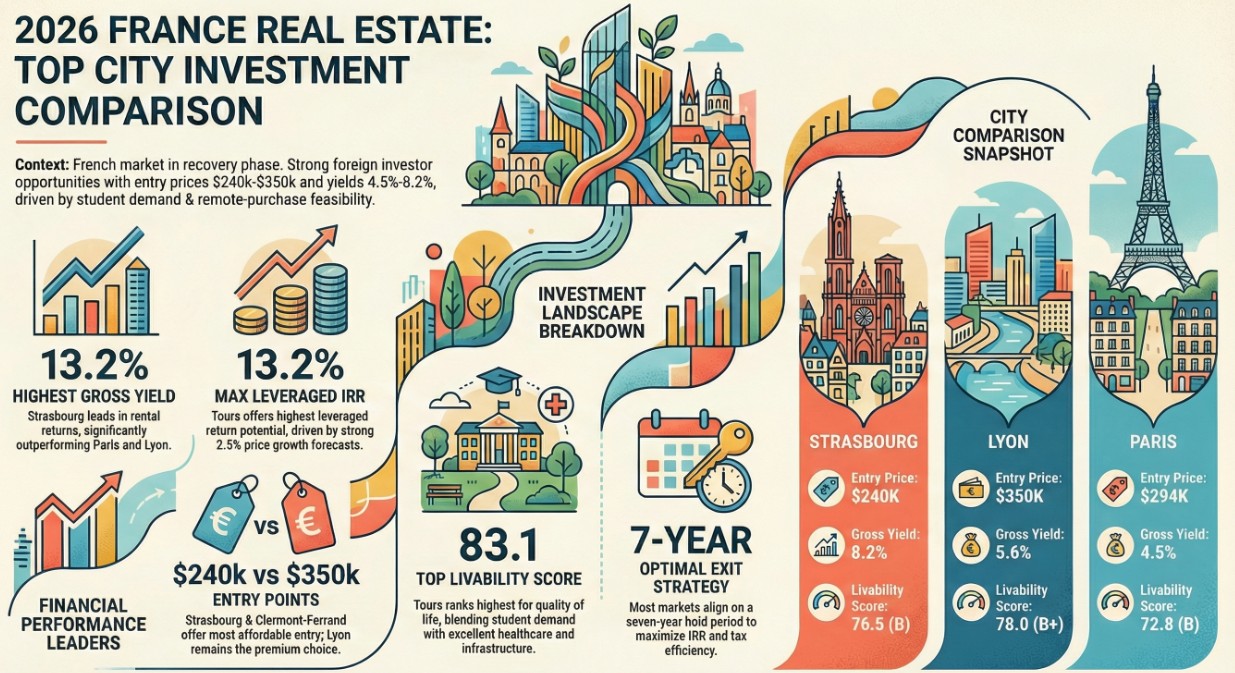
Strasbourg has emerged as a premier destination for investors prioritizing immediate cash flow without sacrificing continental charm. The city currently offers gross yields as high as 8.2%, driven by a recovery phase where prices have remained accessible despite surging demand. The investment case is anchored by the cosmopolitan energy of the EU quarter and the half-timbered charm of neighborhoods like Neudorf. This dual-engine economy attracts both high-income expats and a massive student population, ensuring a diverse tenant pool.
"Strasbourg offers strong investment potential under USD 500k for foreign investors targeting 80-100 sqm apartments in secondary neighborhoods like Cronenbourg, Neudorf Sud, or Koenigshoffen."
The Paris Entry Myth: 18th to 20th Arrondissements
The intuition that Paris is closed to those with a sub-$500k budget is a lingering myth. The "outer arrondissements" offer strategic entry points into the capital's legendary rental market through well-located studios and one-bedroom apartments. In the gritty but high-potential streets of the 19th Arrondissement, a 29 sqm one-bedroom apartment can be secured for approximately $294,000. While yields here are more conservative, ranging from 3.8% to 4.5%, the 2% vacancy rate—the lowest in the country—makes this a 75% confidence "Conditional Buy" for long-term wealth preservation.
The Student City Engine: Lille and Montpellier
The most reliable engine for rental stability in France remains its massive university hubs. In the north, Lille supports more than 100,000+ students, while the sun-drenched streets of Montpellier, located just minutes from the Mediterranean, serve 80,000 students. These cities operate in a constant state of supply-demand imbalance, resulting in strong gross yields of 5.8% in Lille and 5.4% in Montpellier. This environment creates a resilient "recovery-market" play where vacancy is rarely a concern for well-located assets.
"Key neighborhoods like Wazemmes and Fives offer strong rental demand from students and professionals... featuring limited supply in a recovering market."
The Power of Local Leverage: Lyon and Toulouse
For the strategist, the real magic of the French market lies in the ability to use local financing. In Lyon, France’s second-largest business basin, and Toulouse, the nation's soaring aerospace hub, the use of 70% LTV financing significantly amplifies total returns. While cash-on-cash returns may appear modest, the 13% leveraged IRR in Lyon and 12.8% in Toulouse tell a different story. Crucially, French mortgages are fixed-rate—at 3.5% in Lyon and 3.8% in Toulouse—providing a stable hedge against future interest rate volatility over the recommended 7-year hold.
The "Remote Buy" Revolution
The traditional barriers to international ownership have been dismantled by a sophisticated "Remote Buy" infrastructure. Investors can now execute a property acquisition entirely from abroad via Power of Attorney (POA), using an electronic signature or a consulate to finalize documents.
The process is anchored by a vetted network of Notaries, who serve as neutral legal representatives for the state, ensuring title security. Professional firms such as Foncia and Lodgis handle everything from renovations to property management, making cities like Clermont-Ferrand—currently an 85% confidence "Buy"—an easy "arm's-length" addition to a global portfolio.
Conclusion: A New Map for French Investment
The 2026 market marks a definitive transition from speculative plays in Paris to diversified, yield-driven strategies in regional capitals. From the high-yield corridors of Strasbourg to the leveraged growth of Lyon, the regional "under $500k" market is where the most stable opportunities now reside. The data suggests an Optimal Exit after a 7-year hold, allowing investors to capture a full market recovery cycle while reaping the benefits of stable rental income.
If you could own a piece of a world-class French city for the price of a mid-sized US condo, where would you plant your flag first?
Written by
Under500K Team
Research and market insights for global property investors.