Discover why Mexico’s 2026 market goes far beyond beach condos, from nearshoring-fueled industrial hubs to Mérida’s safety and Cancun’s tourism-driven returns.
In 2026, the best-performing asset in the Mexican Republic isn't a beachfront condo in Tulum—it's a 2-bedroom apartment in an industrial corridor. While the "vacation-only" perception of Mexican real estate persists in travel brochures, sophisticated international investors have moved inland. Driven by the tectonic shifts of global nearshoring and record infrastructure investment, Mexico’s urban centers are currently outperforming traditional coastal hubs.
Data-driven insights from six key markets—Cancun, Guadalajara, Mexico City, Monterrey, Mérida, and Querétaro—reveal a landscape where strategic entries under $500,000 are yielding unexpected results. For the strategist, the current "Expansion" phase across these cities represents a rare window for high-alpha diversification.
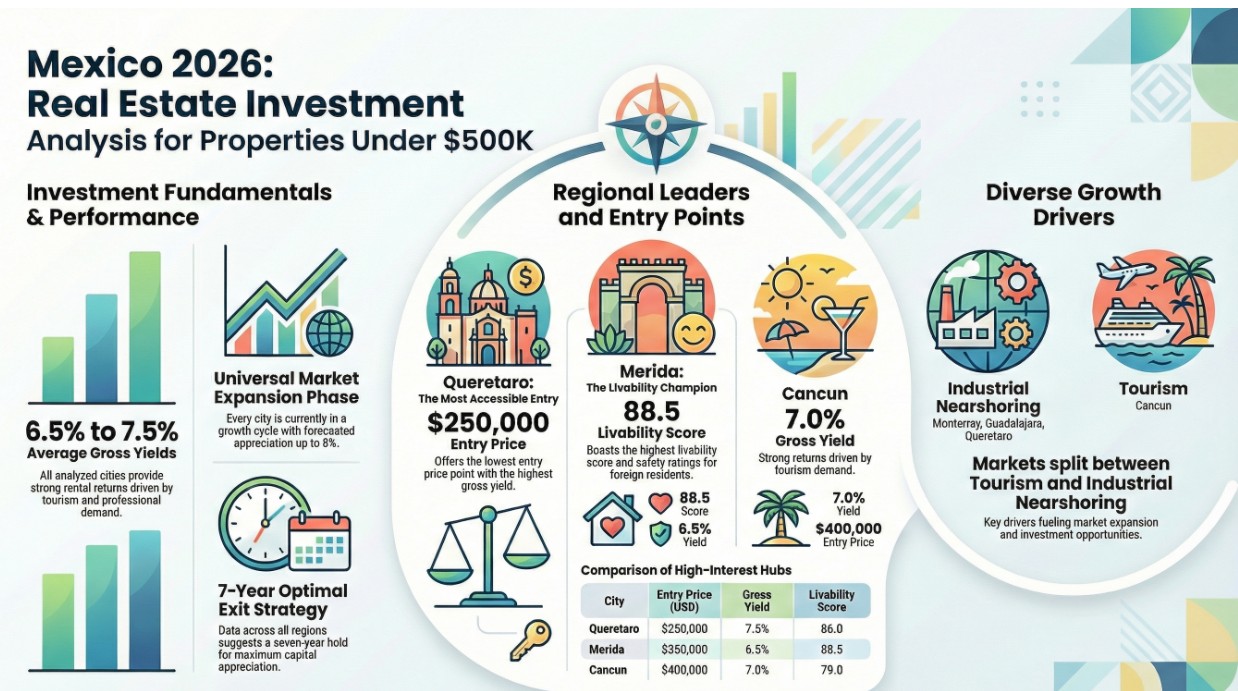
The "Hidden" Entry Point: Luxury for Under $300K
While global inflation has pushed prime entries in the U.S. and Europe into the stratosphere, Mexico’s industrial and cultural capitals remain "hidden" in plain sight. A strategic investor can secure a position in Querétaro for $250,000—a staggering 37% less than the $400,000 entry point required in Cancun. In the global metropolis of Mexico City, the entry barrier is surprisingly low if you know where to look: target neighborhoods like Portales Norte start at just $200,000, while the professional hub of Narvarte begins at $250,000. These aren't budget compromises; they are high-growth entries into markets characterized by chronic housing undersupply and robust professional demand.
The "Nearshoring" Effect is More Than Just Hype
"Nearshoring" has evolved from a board room buzzword into a physical construction lag. Monterrey has emerged as the fastest-growing residential hub in North America, fueled by the arrival of over 80 foreign companies—including giants like Tesla and General Motors—since 2020. This industrial boom has created a persistent housing deficit, as the city struggles to absorb a 1.5% annual population growth. Querétaro mirrors this strength, bolstered by a record-breaking USD 6.38 billion in Foreign Direct Investment (FDI) in 2024.
"Monterrey's real estate market is in a robust expansion phase driven by nearshoring, low unemployment, and population growth, offering strong gross yields of 6-7%." — Executive Summary Statement
This isn't a transient trend; it is a structural shift. With housing starts up 8.2% in 2025 but a pipeline that remains critically low against demand, these industrial corridors are primed for sustained capital appreciation.
The Safety and Livability "Gold Medalist"
For risk-averse capital, Mérida is the undeniable "Gold Medalist." The city boasts the highest Livability Index score of the group at 88.5 (A-), anchored by a world-class safety score of 95. Known as the "White City," Mérida’s reputation for security is rooted in its deep cultural stability and exceptional community policing, making it a primary target for domestic migration and foreign retirees alike. Beyond the lifestyle appeal, federal projects like the Tren Maya are providing the infrastructure backbone necessary to sustain its "strong expansion phase." With a lean 6% vacancy rate, Mérida offers a unique combination of high security and predictable cash flow.
The Universal "7-Year Itch"
Despite the divergent drivers of these six markets—ranging from the tech-driven ecosystem of Guadalajara to the tourism engine of Cancun—the "Optimal Exit" strategy is remarkably universal. Across all reports, data identifies 7 years as the strategic sweet spot for a liquid exit. This window allows investors to capture peak appreciation (averaging 5.5% to 8% annually) while maximizing Capital Gains Tax (CGT) optimization through a fideicomiso (bank trust). Exiting at year seven also mitigates the risk of yield compression that can occur as markets like Monterrey’s Cumbres or Centro corridors reach residential saturation.
Coastal Yields vs. Urban Stability
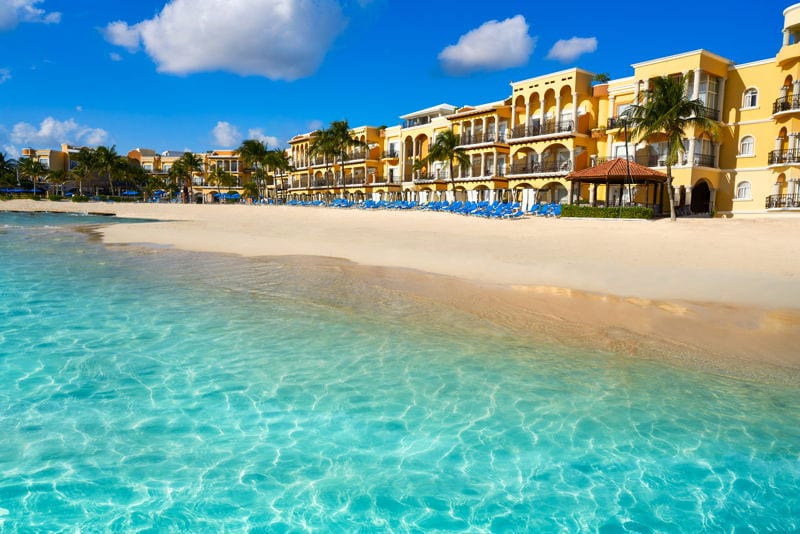
The choice between a coastal and urban investment requires a nuanced understanding of gross vs. net yield. Cancun remains a powerhouse with a 7% gross yield, but the reality of high-intensity tourism management (fees of 20-25%) results in a net yield of 5.5%. Conversely, urban markets like Querétaro offer a 7.5% gross yield with significantly lower management overhead (8-10%), leading to a 4.8% net yield with less operational volatility. Guadalajara, the "Silicon Valley of Mexico," delivers a 6.8% yield supported by an Economic Vitality score of 90 and a Healthcare score of 82, ensuring a stable, high-income tenant base.
When analyzing top-performing neighborhoods, the disparity in strategy becomes clear:
- El Centro (Cancun): 9.5% yield (Driven by Tier 1 tourism demand)
- Colonia Americana (Guadalajara): 9% yield (Fueled by the tech-expat influx)
- Agricola Oriental (Mexico City): 7.6% yield (A strategic Tier 2 "Value" play for urban professionals)
While the coast offers the allure of the Caribbean, the tech and professional hubs offer "steady-state" growth and lower exposure to currency volatility.
The Future of the Mexican Expansion
As we move through 2026, the data confirms that all six analyzed cities remain firmly in the "Expansion" phase. With 12-month growth forecasts hovering between +7.5% and +8%, the window of opportunity for sub-$500,000 entries is active but narrowing.
The fundamental question for the modern investor has shifted. Are you looking for a vacation home that pays its own fideicomiso fees in the Riviera Maya, or are you ready to take a strategic stake in the industrial and technological giants redefining the North American economic map?
Written by
Under500K Team
Research and market insights for global property investors.