Discover why Seoul’s new residency rules push foreign investors toward high-yield secondary cities like Cheongju, Busan, Daejeon, and Daegu in 2026.
1. Introduction: The New Frontier of K-Real Estate
For decades, the standard playbook for South Korean real estate was monocentric: buy in Seoul or don't buy at all. International capital was historically concentrated in the capital’s high-velocity districts, but by 2026, that narrative has hit a definitive "regulatory wall." Following the sweeping legislative shifts of 2025, the friction of entering the Seoul market has reached a tipping point, forcing a strategic migration toward the peninsula's secondary cities.
The "smart money" in 2026 is no longer chasing the prestige of Gangnam; instead, it is pivoting toward a yield-focused "Secondary City" strategy. The under-$500,000 USD segment has emerged as the premier sweet spot for international investors, offering a rare combination of high cash flow and lower regulatory overhead. This report analyzes the 2026 market shifts and identifies the specific industrial growth hubs where the highest risk-adjusted returns now reside.
2. The "Residency Trap": Why Seoul is No Longer for Remote Investors
The primary catalyst for this market evolution is the Permit-Based Regime, which became fully operational in August 2025. This regulation designates Seoul, the majority of Gyeonggi Province, and strategic sectors of Incheon as "Speculative Zones." For the remote investor, these areas now carry significant illiquidity risk due to draconian occupancy mandates.
The most critical friction point is chronological: in these zones, purchase approval must be secured from local authorities before any sales contract is signed. This makes rapid-execution "quick deals" nearly impossible for foreign entities. Furthermore, the regime enforces a mandatory occupancy rule that effectively guts the traditional buy-to-let model in the capital.
"Investors in these zones must reside in the property for two years."
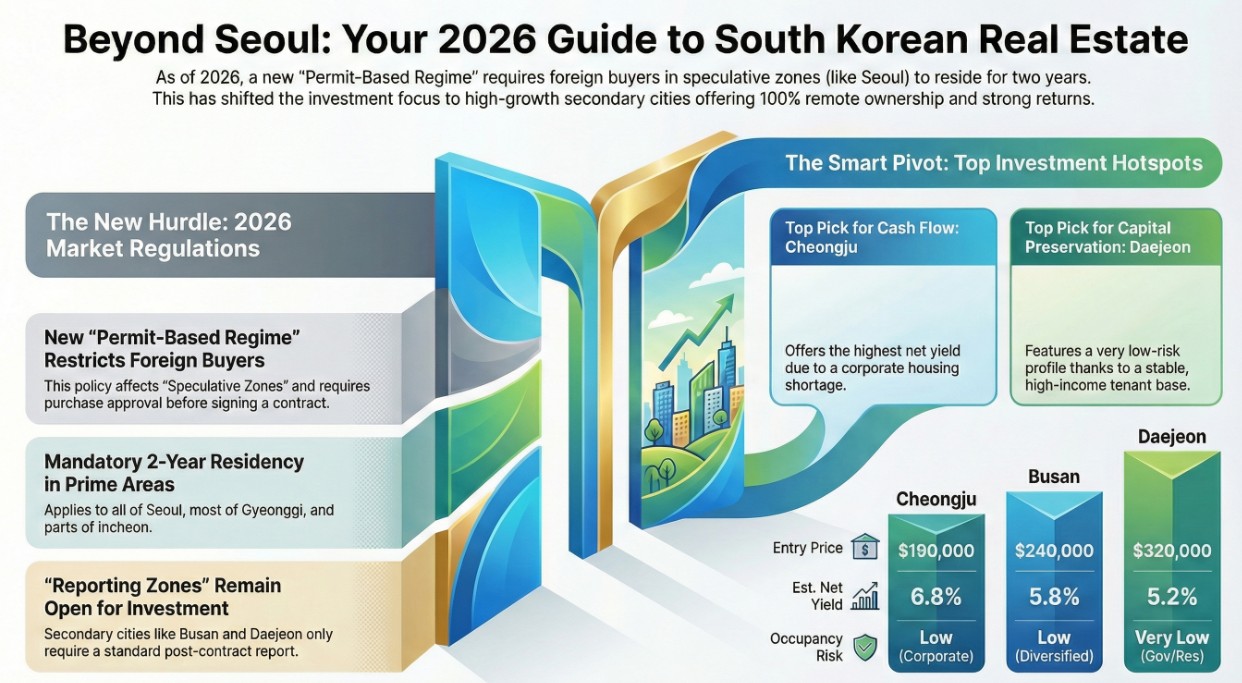
By mandating a two-year physical presence, the government has essentially converted Seoul residential real estate into an owner-occupier asset class, leaving remote investors with no choice but to look elsewhere.
3. The "Reporting Zone" Loophole: 100% Remote Ownership
While the capital is bogged down by occupancy mandates, high-growth hubs like Busan, Daejeon, Cheongju, and Daegu remain classified as "Safe Areas" or "Reporting Zones." These jurisdictions offer a clear path to 100% remote ownership with a standard 60-day post-contract report and no residency mandate. For the strategist, the tax environment in these zones remains highly conducive to the sub-$500,000 entry point. Acquisition tax rates for residential properties are tiered between 1.1% and 3.5%. However, investors must account for the 2026 Capital Gains Tax (CGT) framework: non-residents face a baseline of 20% on net gains or 10% of gross proceeds, whichever is lower. Furthermore, while a 10% VAT applies to the building portion of Officetels, this is often refundable if the asset is formally registered as a rental business—a crucial step for maximizing net yields.
4. Cheongju: The Unexpected High-Yield Winner
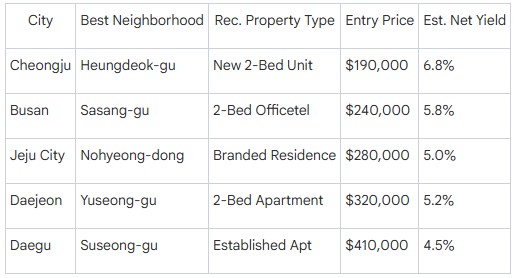
From a pure cash-flow perspective, Cheongju—specifically the Heungdeok-gu district—is the standout performer of 2026. The city’s investment thesis is built on a chronic housing shortage driven by the industrial expansion of SK Hynix. This provides significant downside protection and substantial rental appreciation potential. With entry prices as low as $190,000 for new 2-bed units, Cheongju offers a "High-Yield Growth" profile that Seoul can no longer match.
2026 Secondary City Investment Performance Data (USD)
5. Daejeon: The "Recession-Proof" Tech Hub
While Cheongju is the yield leader, Daejeon (specifically Yuseong-gu) represents the premier "Capital Preservation" play for 2026. This market is anchored by "Tech/R&D Stability," drawing from a tenant base of high-income professionals, government researchers, and the KAIST scientific community. Daejeon offers "Institutional Grade" reliability with very low occupancy risk. Unlike markets susceptible to cyclical swings, the research-heavy economy of Daejeon ensures that high-quality residential assets maintain consistent demand.
"For Capital Preservation, a 2-bedroom apartment in Daejeon (Yuseong-gu) offers the most resilient profile due to its high-income, tech-centric tenant base."
6. Managing from a Distance: The 2026 Digital Toolkit
The democratization of Korean real estate data has made physical proximity unnecessary for professional due diligence. Investors can now monitor "entry-level residential assets" and manage portfolios via three critical digital pillars: • Naver Real Estate: The definitive source for Sil-georae-ga (actual verified transaction prices). This is essential for ensuring that purchase prices are aligned with market reality rather than inflated asking prices. • Zigbang: This platform provides sophisticated 3D visual inspections, allowing for high-fidelity remote tours of specific unit layouts and interior conditions. • Dabang: The optimal tool for tracking lower-end inventory, such as villas and studio apartments in the 200,000–300,000 range, which are often overlooked by larger institutional portals.
7. Conclusion: The Future of the "Secondary City" Strategy
The 2026 South Korean market reflects a fundamental shift from speculative capital appreciation in the capital to strategic, yield-focused positioning in industrial growth hubs. Whether it is the "Value/Recovery" play in Daegu or the "Institutional Grade" stability of Busan, the secondary cities offer a path forward that avoids the residency trap. Furthermore, the current macroeconomic climate provides a unique window for USD-denominated investors. With the exchange rate at approximately 1 USD≈1,450 KRW, purchasing power has significantly expanded for those entering a market where asset prices remain localized. As the Permit-Based Regime reshapes the peninsula, are you positioned in a "Speculative Zone" trap, or are you riding the wave of Korea's industrial growth hubs?
Written by
Under500K Team
Research and market insights for global property investors.