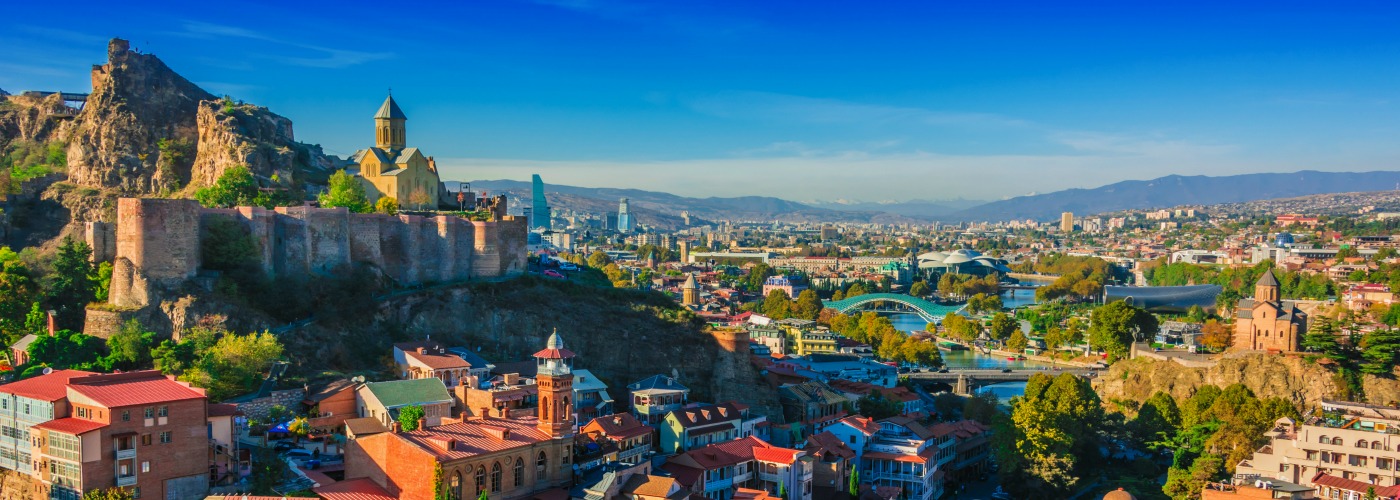
Discover why Tbilisi and Batumi are emerging 2026 hotspots, with 6–8% yields, investor‑friendly taxes, and residency options for $150K–$300K real estate buyers.
-
Introduction: The Emerging Giant at the Crossroads
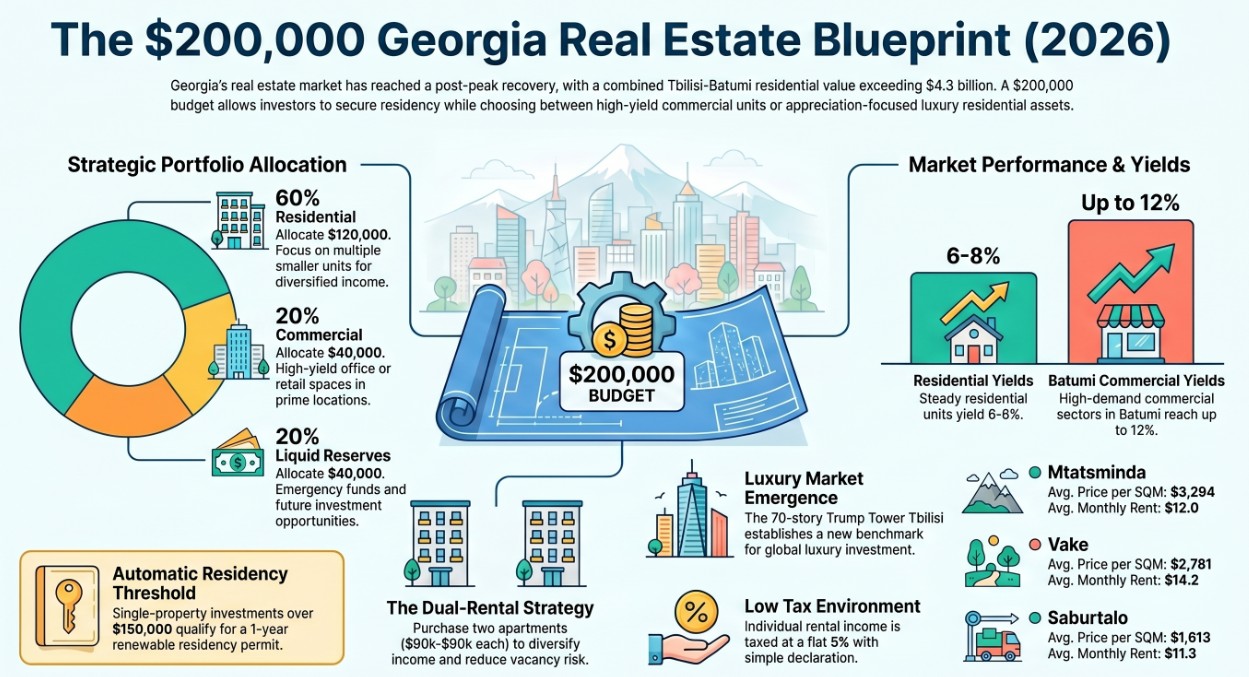
For years, global investment circles discussed Georgia as a "hidden gem"—a boutique market with undeniable charm but limited scale. That narrative has officially dissolved. As of 2026, the combined residential market of Tbilisi and Batumi has matured into a $4.3 billion powerhouse. For the sophisticated investor navigating the stagnant yields and regulatory friction of traditional European markets, Georgia represents a rare frontier of high risk-adjusted returns and a direct path to residency. Within this landscape, a $200,000 budget has emerged as the strategic "sweet spot," offering significant purchasing power in a market increasingly drawing comparisons to early-stage Dubai or Lisbon.
-
The $150,000 Residency "Sweet Spot"
A critical regulatory pivot has redefined the entry strategy for international capital. As of March 1, 2026, the investment threshold for a renewable one-year residence permit was raised from $100,000 to $150,000. While a $200,000 budget comfortably secures this permit, a global strategist looks at the broader residency hierarchy: the separate "Investor Visa," which grants a 5-year permit, requires a $300,000+ commitment.
For the $200,000 investor, the goal is "automatic residency" as a side-benefit of a single-property acquisition. This avoids the logistical complexity of combining smaller holdings to meet the threshold. However, investors must ensure the property's value is verified correctly to satisfy the Ministry of Justice.
"The residency threshold applies to a single qualifying property valuation confirmed by an accredited Georgian appraiser."
-
The Currency Hedge You Didn't Expect: GEL vs. Lira
When weighing regional opportunities, investors frequently compare Georgia to Turkey. In 2026, the data identifies Georgia as the superior "currency hedge." While the Turkish Lira continues to grapple with double-digit persistent inflation and high volatility, the Georgian Lari (GEL) has demonstrated remarkable resilience, strengthening by 4.65% against the USD in 2025.
Furthermore, Georgia maintains a manageable inflation rate of 4–6%, providing a level of capital preservation that Turkey's economy currently lacks. The Georgian market’s "dollarized pricing"—where property contracts are quoted in USD—acts as a natural shield for international capital. This stability translates directly to the bottom line: Tbilisi residential assets are delivering consistent 6–8% gross yields, whereas Istanbul has seen yields compressed to the 4–6% range, with returns often further eroded by local currency devaluation.
-
From "Old World" to "Sky-High": The 70-Story Landmark Shift
The announcement of Trump Tower Tbilisi has signaled Georgia’s definitive transition into a global gateway for business. Rising 70 stories over Central Park, this project will be the tallest building in Georgia and represents the first Trump-branded development in the region. This is more than a luxury skyscraper; it is a marker of "early-stage Dubai" momentum, where globally recognized standards of excellence begin to anchor new districts of high-end retail and international commerce.
"The Trump name is synonymous with some of the most luxurious real estate developments in the world, and Trump Tower Tbilisi stands as a continuation of that legacy. We are proud to bring this globally recognized standard of excellence to Georgia." — Eric Trump, Executive Vice President of The Trump Organization.
-
The "Dual-Portfolio" Diversification Strategy
For a $200,000 budget, the most sophisticated play is not "one big house," but a diversified "Dual Rental Portfolio." However, a strategist knows that a $200,000 budget actually means a 170,000–180,000 acquisition spend, with a vital 20,000–30,000 held in reserve capital for renovations and liquidity.
By splitting the remaining capital, an investor can acquire units in distinct Tbilisi districts to mitigate vacancy risk. For example, a unit in Saburtalo captures demand from young professionals and students, while a unit in Isani serves government employees and family hubs. This geographical spread can reduce aggregate vacancy risk by 30–50%. While premium outliers like Mtatsminda and Vake reached highs of 3,294–3,300/sqm in early 2025, emerging districts still offer high-quality inventory in the 1,100–1,400/sqm range.
Efficiency is a hallmark of this market; the National Agency of Public Registry (NAPR) typically completes registrations in four days, with same-day expedited services available for fast closing.
-
The Batumi Commercial "Yield Engine"
While Tbilisi provides long-term stability, Batumi serves as the region's high-impact yield engine. In the Old Boulevard waterfront zone, gross yields for commercial spaces reach 10–13% during the peak summer months. However, transparency is key for the strategist: these yields often dip to 4–6% during the winter. To stabilize year-round returns, investors must target sectors with less seasonal volatility or secure year-round tenants.
The commercial landscape is divided into four strategic zones:
- Old Boulevard: Maximum summer foot traffic; ideal for hospitality.
- Angisa District: Service-oriented (salons, fitness); consistent year-round local demand.
- New Boulevard: Targeted at the tech and remote-work sector.
- Khimshiashvili Street: A main artery balancing tourist and resident traffic.
For those requiring rapid exit liquidity or fast closing, services like Werty have become essential, allowing investors to convert cryptocurrency into USD or GEL to facilitate immediate deposits and capture undervalued listings.
-
Conclusion: The Future of the Georgian Frontier
As we progress through 2026, the fundamentals of the Georgian market—urbanization, declining household sizes, and high-tier yields—remain robust. The "hidden gem" phase has ended, replaced by an era of institutional-grade growth and international luxury standards. For the modern investor, the pivot from saturated, low-yield European markets to the Georgian frontier is no longer a speculative move; it is a calculated strategy for capital appreciation and residency in a volatile world. The question is: are you ready to act before the window of "early-stage" pricing closes for good?
For additional details and a full city report for Tbilisi check this link: https://www.under500k.ai/reports/tbilisi-georgia-20260521-103317
Written by
Under500K Team
Research and market insights for global property investors.